
Episode 70: The Antidotes to Distraction, Dispersion, and Drift
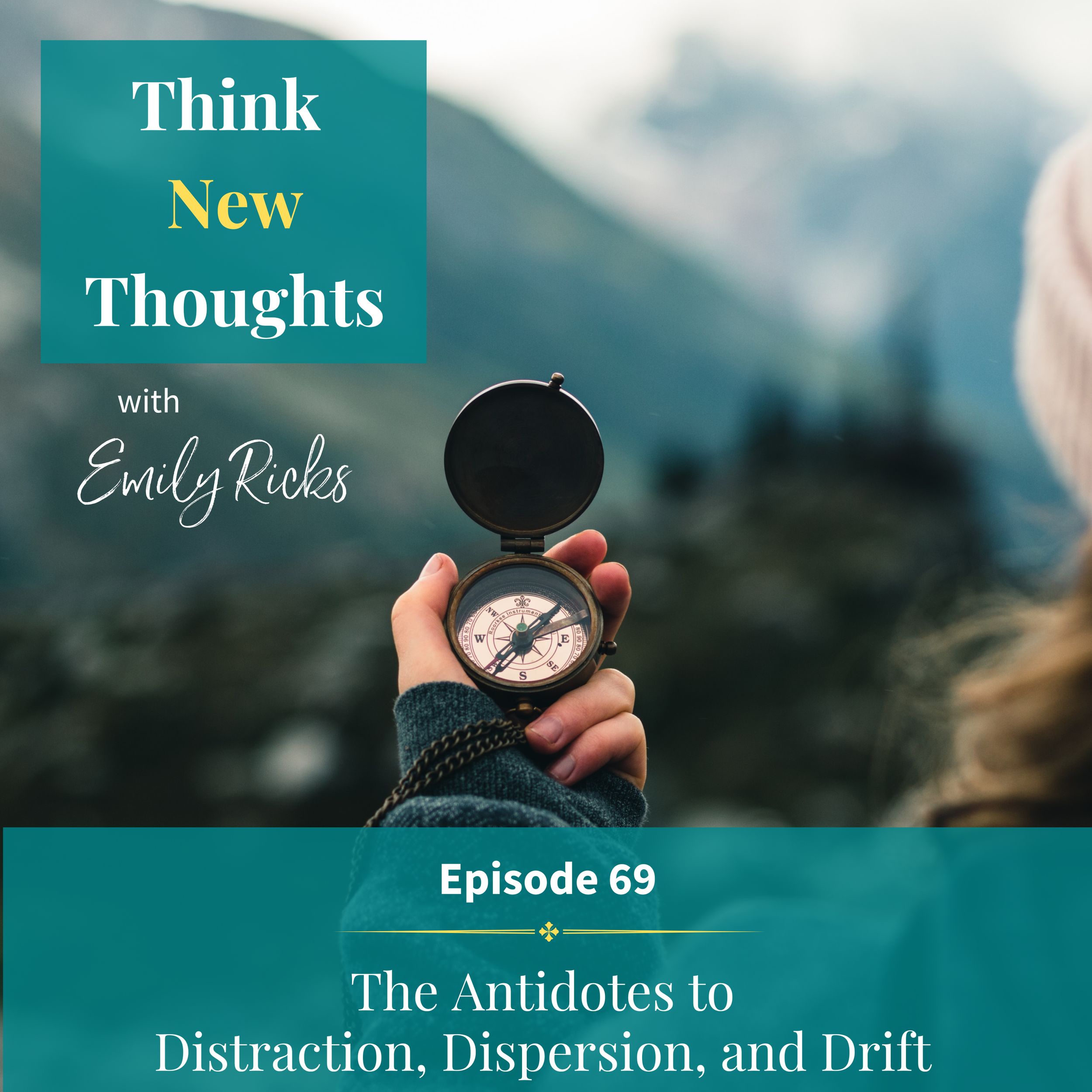
There are 3 D’s that can quietly steal your goals: distraction, dispersion, and drift. In this follow-up episode from last week, I’m sharing what to do when they inevitably show up. I’ll walk you through the antidote to each one—simple, practical ways to regain clarity, focus your energy, and gently course-correct when you get off track. If you’re ready to stay oriented, focused, and moving forward—even when things get messy—this episode is for you.
Take the ideas on the podcast to a deeper level inside the Think New Thoughts Academy
Learn More
Come to my next Free Webinar: Stop Being Mean To Yourself
Register Here
Full Transcript:
You're listening to the Think New Thoughts Podcast with Emily Ricks, episode number 70, The Antidotes to Distraction, Dispersion, and Drift.
I'm Emily Ricks, and this is Think New Thoughts, a life coaching podcast to help you find more joy in your relationships. In each episode, I'll share a simple idea that will help you see things in a new way, so you can love God, your neighbor, and yourself more deeply than you ever have before. If you're ready to literally change your mind, I think you'll like it here.
Hey, how's it going? So, I want you to think about a hero's journey, like maybe one of your favorite heroes, Harry Potter, or Luke Skywalker, or Katniss Everdeen, whoever it is for you. And think about that a hero has a goal, or a quest, and then faces tons of obstacles.
And the story, whether you read that in a book or you watch it in a movie, is full of twists and turns and suspense. And what we want to watch and experience is how the hero overcomes those challenges. And there are some things in life that we can prevent or avoid, and I'm all for that in certain situations, but our favorite heroes are not the ones who stay safe and quiet to the side and are able to prevent or avoid ever having any obstacles on their path.
A real hero is somebody who faces an obstacle and ultimately, through cleverness and grit and help from friends, and maybe a little magic, is able to overcome the obstacle. Last week, we talked about the three D's that can steal your next goal. The three obstacles that are going to crop up on your path anytime you set a goal and start working on it.
Do you remember what they were? The first is distraction. When you get pulled into stuff that feels urgent, but is actually less important than what you want to be working toward. The second one is dispersion.
When your time or energy or focus is spread so thin that you expend a lot of effort, but make very little progress. And the third is drift. When you slowly get off course and your trajectory is no longer leading to the destination that you had at the beginning.
So today I want to share a strategy for overcoming each of these three D's. And I want to be really clear about the goal here. The objective isn't to never get distracted.
That's going to happen. It isn't to make sure your time or energy is never dispersed because it will be. We're not trying to guarantee that you'll never drift a few degrees off course because you will.
So this episode isn't about preventing distraction, dispersion, and drift. It's about the antidotes to that. An antidote is something you take to counteract the effect of a poison.
And as you set goals and move forward, I want you to have tools you can reach for when you notice yourself getting distracted, spread thin or veering off course so that you can respond and get back on track instead of getting discouraged and choosing to give up. So the antidote to distraction is clarity. Remember a distraction is an urgent or otherwise enticing lower value activity that pulls you away from what you previously designated as a top priority.
So if you don't have clarity about what your priorities really are, you get distracted very easily. If you aren't really clear about what the high value activities are in your life, you're going to end up chasing after lower value activities, whatever happens to pop up in the moment. So let's say you have a goal to read more scripture.
For example, a distraction might be notifications on your phone that ding and pull your attention away from what you're reading. But if you really have clarity that reading scripture is a higher value activity for you in the long run than scrolling on your phone, if you have decided that, then you can say out loud in the moment, Oh, I'm getting distracted by something that's a lower value activity right now. I want to choose the higher value option here.
This serves me in the long run. I know this is more beneficial to me in the end. And this kind of clarity comes from taking time to write and think about what matters most to you.
There's lots of different ways that you can do this. I have a values assessment that I personally sit down and do multiple times a year. It gives me clarity to help me decide day to day, what my highest value activities are and aren't.
And it changes a little bit in different seasons of my life. What matters very most when I notice myself getting distracted, I can call that out and say, I'm not aligned with my values here. I think I'm zigzagging away from true North, but in order to be able to do that, I have to be clear about what my values are.
Every few months. I also write down a few emotions that I'm aiming to feel more often. And a few emotions I'm aiming to feel less often in my life.
And I clarify what kind of thoughts will create those emotions for me. This clarity helps me in the moment to notice when I get distracted by fear or worry or resentment. And then I can make intentional decisions to guide my thinking toward thoughts that create trust, patience, and acceptance.
I have clarifying conversations with my husband about what we're aiming to accomplish as parents. What is the whole point? What are we trying to do here? And then when I get distracted by a desire to control or punish or lecture, I can drink some of that clarity as an antidote to the poison and remind myself, like all of that is a zigzag away from our true North of what we're really trying to accomplish as parents. So clarity will help you recognize distraction sooner and sooner.
The more clear you are about your true priorities, the less enticing distractions will start to feel to you. So for you to establish more clarity in your life, here's a question you can ask. What do I really, really, really want? And then I encourage you to think about that, to write about it, to pray about it, and do this often.
The more clear you are about what really matters and what you really want, the easier it will be for you to stay focused on that thing rather than zigzagging your attention around. So clarity is the antidote to distraction. So with any goal that you're working on, arm yourself with as much clarity as you can, and then drink it up when you feel yourself getting pulled into distraction.
The antidote to dispersion is focus. Dispersion is what's happening when you feel spread too thin and discouraged that you're not seeing progress, even though you're working really hard. So focus means channeling resources in one direction for a period of time, like a pressure washer, instead of just letting the water drip out of holes in the hose all day long.
The principle of focus is basically fewer things or fewer things at a time. So one strategy here, if you can take some things completely off the list or completely off your plate, if you really want to achieve a goal or finish a project, try this, take a few minutes and write down what you're going to not do to free up time and energy to do this. And this might sound really obvious, but very few people actually think of it this way.
We tend to think that accomplishment is always something we add to our lives. But a lot of times what we subtract is actually a key ingredient to success. So dispersion is having 10 decluttering projects on your list for this week.
Focus might be choosing two projects this month and two for next month. So you can really make progress and complete them instead of chasing your tail on seven or eight, but not actually finishing any of them. Can you feel the difference between dispersion and focus? Dispersion might be feeling every day, like you're behind on laundry and tidying and cleaning and organizing in your home.
Focus might be having one day where you tidy and six days where you don't, or maybe 10 minutes a day where you focus on tidying and 23 hours and 50 minutes where you don't think about it. Focus might be having one day of the week where you do laundry and six days that you don't. Applying this principle of focus to combat dispersion isn't a one size fits all antidote, but see if you can find ways that will work for you to do fewer things in general or attend to fewer things at a time.
So you can concentrate your energy and time for more impact. The antidote to dispersion is focus. And finally, the antidote to drift is checkpoints.
I saw a thing one time about a study that was done to measure people's ability to walk in a straight line. They took the research participants out to a densely wooded forest and gave them instructions to walk in a straight line. And they put a GPS tracker on their backpacks to capture their trajectory as they walked around.
And at the end, most of the people felt that they had done a pretty good job. They thought they'd walked in a pretty straight line through the forest. But the GPS told a very different story.
When they looked at it, they could see that they actually winded and weaved all over the place. Most of their maps looked more like circles than lines. And they had no idea while it was happening.
Physically or metaphorically, we really can't walk in a straight line just by trying to, but if we use instruments or tools, then we can. So imagine if you had a compass and every so often you could check in and see if you were still heading north, that would make a big difference in being able to walk in a straight line. Or if you had trees that had yellow scarves on them, maybe marked like every 300 yards.
And that way, if you drifted, you could look for a yellow scarf and come back to center every time that you saw one. So that's what checkpoints do. They're the strategy to help you combat drift.
So some common checkpoints might be something like going to church each Sunday. That can help combat spiritual drift and bring you back to center. I hop on the scale every morning as a checkpoint so I don't wake up in three months surprised by how far I've drifted off course.
My mind tends to drift toward the negative and toward complaining about things in my life, so I have a checkpoint of writing a few lines of gratitude every morning. And this doesn't prevent drift. I still drift, but it gives me a chance to course correct just a few degrees each day.
The pilot of an airplane doesn't set the course to New York City and then sit back and hope that the plane arrives there. He has instruments, he has a compass, navigation systems, and constant feedback about altitude, speed, and direction. And throughout the entire flight, he's making small adjustments.
That's how it can be for you too as you set goals and work toward them. Just like a pilot, you can expect drift. Wind, weather, and air traffic are going to push his plane off course just like all sorts of things are going to come up to try to steal your goal.
So the job isn't to fly perfectly straight, it's to use instruments and tools to keep checking in and correcting the course so that you can arrive at the destination. So as you think about your own goals, maybe ask yourself, what are my checkpoints on this? Where can I regularly pause, look at the data, and gently bring myself back to center? A lot of people set goals and they come up against an obstacle and then that makes them want to give up. They say, well, I was going to work toward a goal but now there's a big wall that I can't climb so I guess I can't really do this.
Or I started out so good but now I'm off course so I guess I'm not cut out to achieve this. And what I want to tell you is you are going to get off course, this is the human condition, but your work to do is to simply bring yourself back over and over again and again as many times as it takes. You can expect distraction, dispersion, and drift to come knocking at your door and then you can use these antidotes to respond in a way that will get you back on track and ultimately help you overcome what's standing in your way.
As you move forward, keep it simple. When you notice you're getting distracted, you can pause and seek clarity. When you feel spread too thin, look for ways to sharpen your focus.
And when you drift, and you will, you can use checkpoints to gently bring yourself back on course. If you're working toward big goals this year, and I really hope you are, you don't have to do it alone. This is exactly the kind of work we do inside the Think New Thoughts Academy.
It's my monthly coaching program designed to help you stay clear, focused, and mentally aligned with where you actually want to go. You'll get regular checkpoints so drift doesn't take over, a live group workshop each month, a private coaching session with me, and access to tools that help you interrupt negative thought patterns and keep moving forward with intention. If you've been enjoying the podcast and want to take these ideas deeper, if you want support applying them in real life, I'd love to invite you to join us.
You can learn more and sign up at emilyrickscoaching.com forward slash join. I'd truly love to work with you. Thanks for joining me today.
