
Episode 75: Overriding Your Primitive Brain
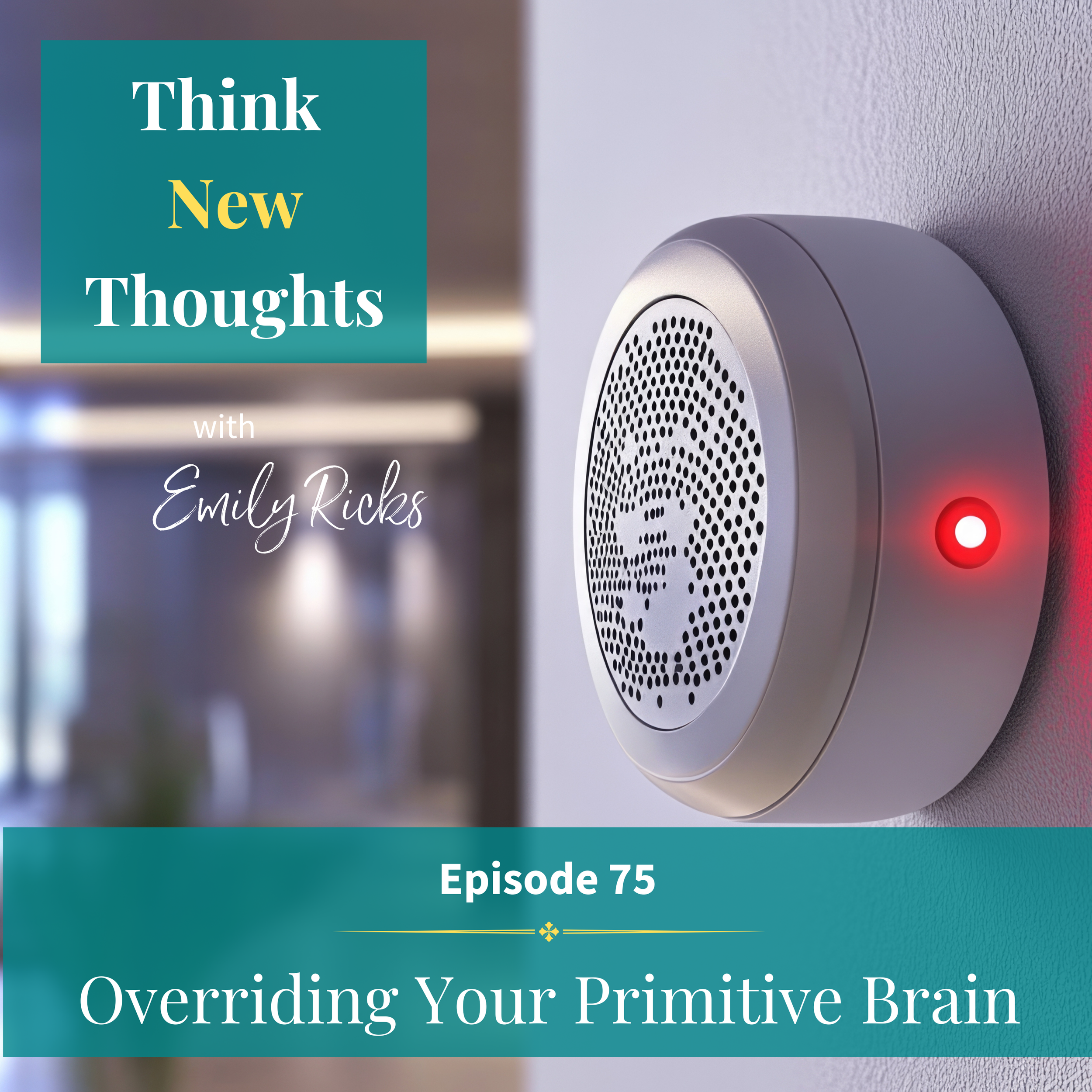
Do you ever feel like you’re at war with yourself? Yesterday you decided all the amazing things you were going to accomplish today… but when it’s time to follow through, you suddenly have 20 reasons to do something else instead. In this episode, I’m sharing what’s actually happening inside your brain when you avoid the very things that matter most to you — and why your brain isn’t broken… it’s just doing its job. Tune in to learn how to become the one in the cockpit who calls the shots, instead of letting your primitive brain run the show.
Curious about coaching?
Schedule a free mini session with me to see what it's like!
Are you tired of constant negative self talk?
Come to my free webinar: Stop Being Mean To Yourself
Register Here
Full Transcript:
You're listening to the Think New Thoughts Podcast with Emily Ricks, episode number 75, Overriding Your Primitive Brain.
I'm Emily Ricks, and this is Think New Thoughts, a life coaching podcast to help you find more joy in your relationships. In each episode, I'll share a simple idea that will help you see things in a new way, so you can love God, your neighbor, and yourself more deeply than you ever have before. If you're ready to literally change your mind, I think you'll like it here.
Hello, my friend. How are you today? I want to tell you about our smoke alarm in the kitchen.
We got a new one several months ago, and it's ultra sensitive. Like, I can put some potatoes in the oven, and then when I open the oven to take them out, they're not burned at all, and there's not even any smoke, but somehow the smoke alarm goes off and starts beeping. And it's super loud, and it disrupts whatever else is happening at the time, and there's no actual smoke or fire, but the smoke alarm is going nuts.
And the smoke alarm is designed to beep if something catches on fire, so we can take action in a situation that might harm someone or burn our house down, right? But our alarm is an overachiever. It lets us know any time the temperature gets drastically hot, even if there's no smoke or fire. So it's actually kind annoying.
Like a little while ago on a school day, we heard the smoke alarm go off at like 6.15 in the morning, and my daughter came staggering out of her room in her pajamas, wondering if the house was burning down. And my older son came up the stairs to explain what was going on, and he threw up his hands, and he was like, I made toast. Like, he didn't burn toast, he just put bread in the toaster and made regular old toast, and then the smoke alarm went off.
And then when the smoke alarm goes off in the kitchen, all the other smoke alarms in the house get triggered and they start beeping too. So he was super annoyed that making toast caused all that commotion early in the morning. So the first few times that the smoke alarm went off when there wasn't really smoke or fire, it was really jarring.
But we've kind of gotten used to it now, so we just know that the smoke alarm in the kitchen might beep even when nothing is on fire. So I've learned that the first job is not to panic, it's just to assess. So when I hear it go off, here's what I do.
I scan the kitchen, I check the oven and the stove and look around and just see if there's actual smoke or fire in my kitchen. And if I'm cooking something, I can acknowledge, okay, yeah, we just had kind of an extreme temperature change when I opened the oven just now, and that's probably what triggered the alarm, but it's a false alarm. After a quick look around, when I can deduce that we're not actually in danger, I hop up on a chair, I hold the button to cancel the alarm, and in a little bit, it stops beeping.
And a little bit after that, the other alarms in the house also stop beeping, and I just move on and finish making dinner. And I can appreciate that the smoke alarm might be useful to me in the event that our house catches on fire. And I can also override the alarm if it's beeping and I'm not actually in danger.
Your brain has a smoke alarm too, and it's really useful for certain situations. And it's also kind of annoying when it starts beeping when all you're doing is making toast. So I want to give you a little more concrete understanding of what happens inside your brain so you can be empowered to override it sometimes when doing so is for your highest good.
So we have different layers in our brains, layers that have evolved over the centuries. And one of those layers is what we call your primitive brain. And this part is very close to the brain of animals, and it's wired for survival.
So there's something called the motivational triad that kind of explains what this part of the brain is always seeking, what motivates it. And again, this is for survival. The motivational triad is seek pleasure, avoid pain, and conserve energy.
And this has served us very well in the past, our ancestors, right? It got us out of the cave. It got us moving. It got us eating, procreating, building shelter, taking care of our own comfort in this world.
The problem is at this point, we have so many ways to seek pleasure, so many ways to avoid pain, and so many ways to conserve energy and not do anything that this motivational triad often works against us. Your primitive brain, so that's the part that just is for survival. It wants to seek pleasure, avoid pain, and conserve energy.
It just sees the here and now, but it doesn't really think too far into the future. So when your alarm clock goes off early in the morning, when it's time to make a healthy meal, when it's time to exercise, when it's time to take action that's for your highest good, your primitive brain will start beeping like my kitchen smoke alarm. And it'll be like, Oh, no, no, no.
We just want to seek pleasure. We just want to avoid pain. We just want to conserve energy.
Like, no, you don't really need to do that today. That's going to take energy. Well, let's put that off until tomorrow.
That's going to be uncomfortable. Your primitive brain will start beeping. Like why would we put ourselves in harm's way when we have a phone and a comfy couch and food in the fridge, like just relax.
So that's your primitive brain, which in certain situations regarding survival is very, very useful to you, but in other situations, it works against you. So let's talk about another part of your brain, which is your prefrontal cortex. This is the more evolved part of your brain.
And it thinks ahead. What would be good for us tomorrow, next week in 10 years, what's going to us in the long run? The prefrontal cortex wants you not just to be comfortable and survive, but it wants you to have a life filled with meaning and purpose and satisfaction. And doing this actually requires the opposite of the motivational triad.
So in order to live this life of meaning and purpose and satisfaction and growth, you actually need to embrace discomfort, delay pleasure and generate energy. So it's totally the opposite of that motivational triad that's happening for your survival brain of wanting to seek pleasure, avoid pain, conserve energy. This is what we want.
And this other half of you is like, no, we need to embrace discomfort. We need to do things on purpose that might be uncomfortable because it's for our highest good. We need to delay pleasure and not have it now because that's going to be what's best for us in the end.
We need to generate and utilize energy to focus on something that's really important. And so there can be kind of a conflict of those two parts of your brain at war with each other. And so here's what happens without a clear intention.
We tend to default to the mood of the moment. So if we're hungry, we're going to act on an urge to eat food, no matter what kind of food it is, whatever food is there, we're going to eat it. Unless we have a clear intention that we set in our prefrontal cortex ahead of time that says, you know, I'm not going to eat more calories than my body needs for fuel.
And so even if I have this urge coming from my primitive brain, like, Hey, there's food on the counter. You should eat that. I might say, well, okay, I know you want to seek the pleasure of that food right now, but this is not a survival situation.
And I'm going to make a decision that's going to benefit me in the longterm and maybe not eat this right now without a clear intention. We tend to default to the mood of the moment. So if I disagree with someone, I might start an argument with them or make a super rude comment, because that would be the mood of the moment.
That would be the easiest thing to just do without thinking, unless I have a clear intention that I have set with my prefrontal cortex ahead of time that I want to be a person who is a peacemaker and who brings people together and speaks with respect. And then if that's my intention, then I would override the primitive urge that I'm having in the moment to get upset and angry. And instead I would make the decision that requires more mental energy, which is to remain calm and to show up in a respectful way that actually takes more energy, more discipline in the moment, but it benefits me in the longterm.
So if I choose to remain calm in that situation, I'm acting from my prefrontal cortex rather than letting my primitive brain run the show. So let's go back to my kitchen smoke alarm. It's designed to protect me and to alert me of danger, but sometimes it beeps when there's no danger.
So I get up on that chair and I push the button to override the alarm because I can tell the difference between heat for me opening my oven and an actual fire. Your brain is designed to protect you, to help you survive, but a lot of times it beeps about stuff that actually isn't going to harm you. And in fact, if you listen to it all the time, you'll end up making choices that are not the best for your longterm growth.
If you want to live a life that's filled with purpose, you actually need to learn how to assess the actual threats and sometimes override your primitive brain, get up on a chair and turn it off when it's working against you. So some coaches will call this overcoming daily resistance. Here's what I want you to know.
Your primitive brain is going to beep every day. Anytime you plan to do something that requires effort or might be uncomfortable, or anytime there's a possible pleasure that's available to you, your primitive brain is going to be beeping. And every day your primitive brain is going to say, don't do that.
That'll be hard. That'll be unpleasant. Ooh, let's do this pleasurable thing right now.
So what I want to offer you today is to just be aware of it. Be aware of when your primitive brain is beeping and see if you can start noticing what that is. When the alarm goes off, notice that it's going, ah, let's conserve energy.
Oh, let's seek pleasure. No, no, let's avoid pain. And when the alarm goes off, you be the one in the cockpit.
You be the one to ultimately decide, is this a good reason to beep or do we need to override it right now? And so you might say something like, yeah, I know brain that you want to delay pain and conserve energy right now. I hear you, but that's not for our highest good in this situation. So actually we are going to exercise, even though that's going to be uncomfortable.
Actually, we're not going to eat that thing that looks really yummy right now. Actually, we are going to have that hard conversation that, you know, is going to be uncomfortable because that's for our highest good in the end. So to overcome daily resistance, to overcome this daily beeping of your primitive brain, one of the best things you can do is make decisions ahead of time that are for your highest good.
You make those decisions from the rational, logical thinking part of your prefrontal cortex rather than with your animal instinct brain. And then you expect your primitive brain to not want to do what you've decided to do when it's time. Just know that that's going to happen.
Your primitive brain will make excuses. It's going to try to get you not to do things that you previously identified as a top priority. And it will use things like, no, let's just relax.
No, that's going to be hard. That's going to be confusing. That's going to take a lot of energy.
That's going to be uncomfortable. Let's do something pleasurable instead. And so today I just want you to start noticing that push and pull inside of you, the part of you that wants to set goals, accomplish meaningful things, live in accordance with your long-term vision of what's really important to you.
That's your prefrontal cortex. And that part of you fights with your primitive brain, which wants to avoid pain and seek pleasure and conserve energy. And so your primitive brain is putting up that fight being like, no, no, no, let's not do that.
And that's a lot of beeping. But most of the time, when you look at it, nothing is on fire. So I just want to empower you to start noticing that notice that your primitive brain wants to avoid anything uncomfortable.
It wants to seek pleasure and it wants to conserve energy. And you can acknowledge that and say, yeah, it makes sense why you want that. And there are situations where your primitive brain is going to be really useful to you.
If you're under attack, or if something is really going to harm you, your primitive brain will launch you into fight or flight and you'll take action immediately. And that will be for your highest good in that moment. But many other times it's just a lot of beeping and you're making toast.
So I want you to know that you can override it. You can be the one in the cockpit. You can make decisions based on what's best for you in the long term until your primitive brain, like, yeah, I get that.
You don't want that, but we're looking further ahead than right this minute, which means I'm going to turn that alarm off right now. And we're going to opt into that uncomfortable thing on purpose. Any change we want to make in our lives always begins with awareness.
So just start noticing this. Notice when you're making decisions from your primitive brain and when you're making decisions from your higher brain. Notice when your primitive brain is beeping trying to get you not to do stuff that takes energy.
And then you decide what's going to be for your highest good in the end. This is how you move toward living a life filled with meaning and growth and purpose. Sometimes you get up on a chair and you override that primitive brain when it's actually working against you.
All right, start noticing it this week and see what you discover. And if you've been enjoying the podcast and haven't left a review yet, please go do that. I'm hoping to get three more reviews by the end of February.
So thank you for helping me share these ideas with other people who can benefit. Thanks so much for joining me today. I'll talk to you next week.
