
Episode 80: The Acceptance Paradox
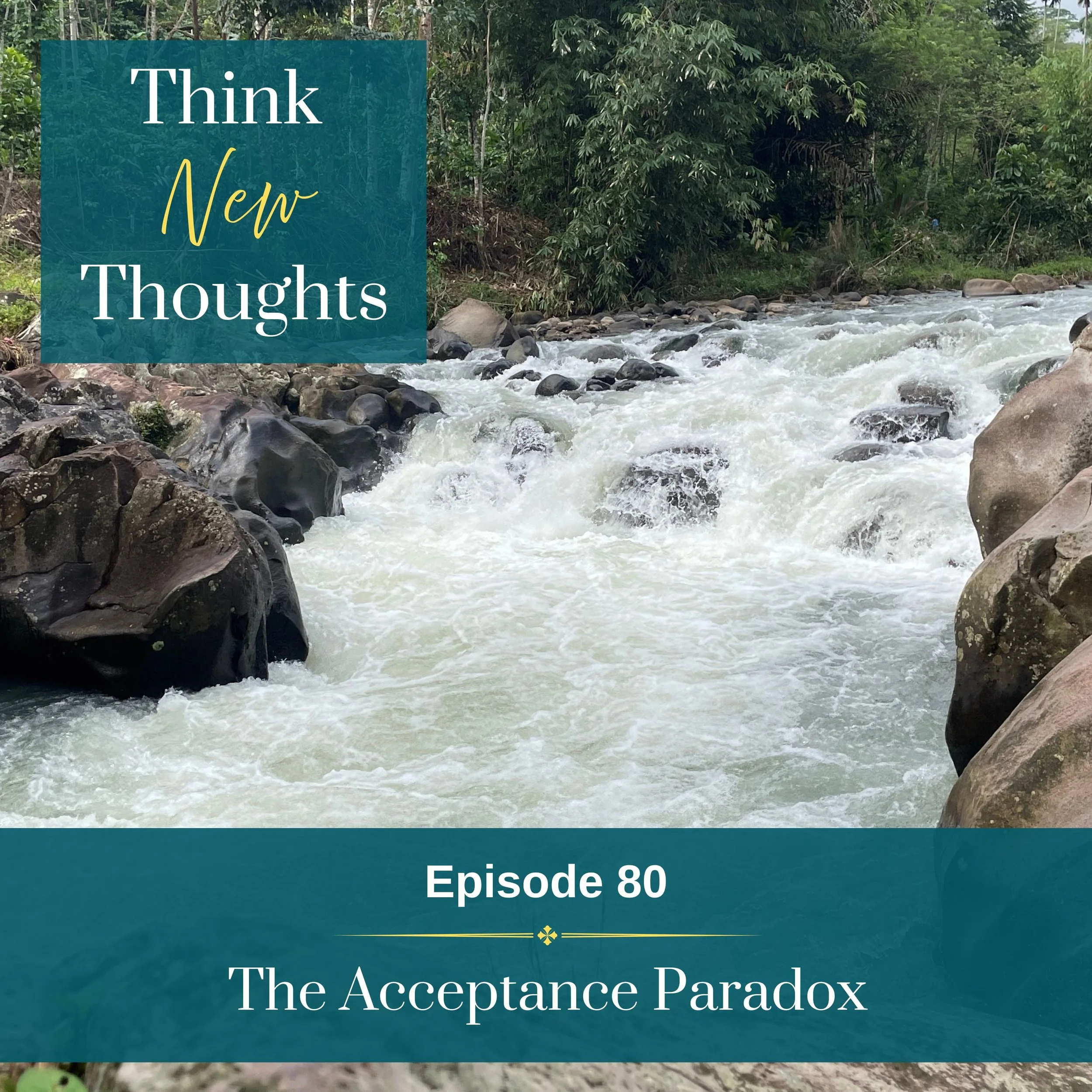
In this episode, I’m sharing a simple idea that sounds a little backwards at first: the more we fight our emotions, the further we get from being able to change them. I talk about what happens when we stop telling ourselves we shouldn’t feel what we’re feeling and instead learn to accept it with honesty and curiosity. Paradoxically, that acceptance is often the very thing that makes real change possible. If you’ve ever felt stuck trying to force yourself to be more patient, grateful, or loving, this idea might give you a much gentler and more effective way forward.
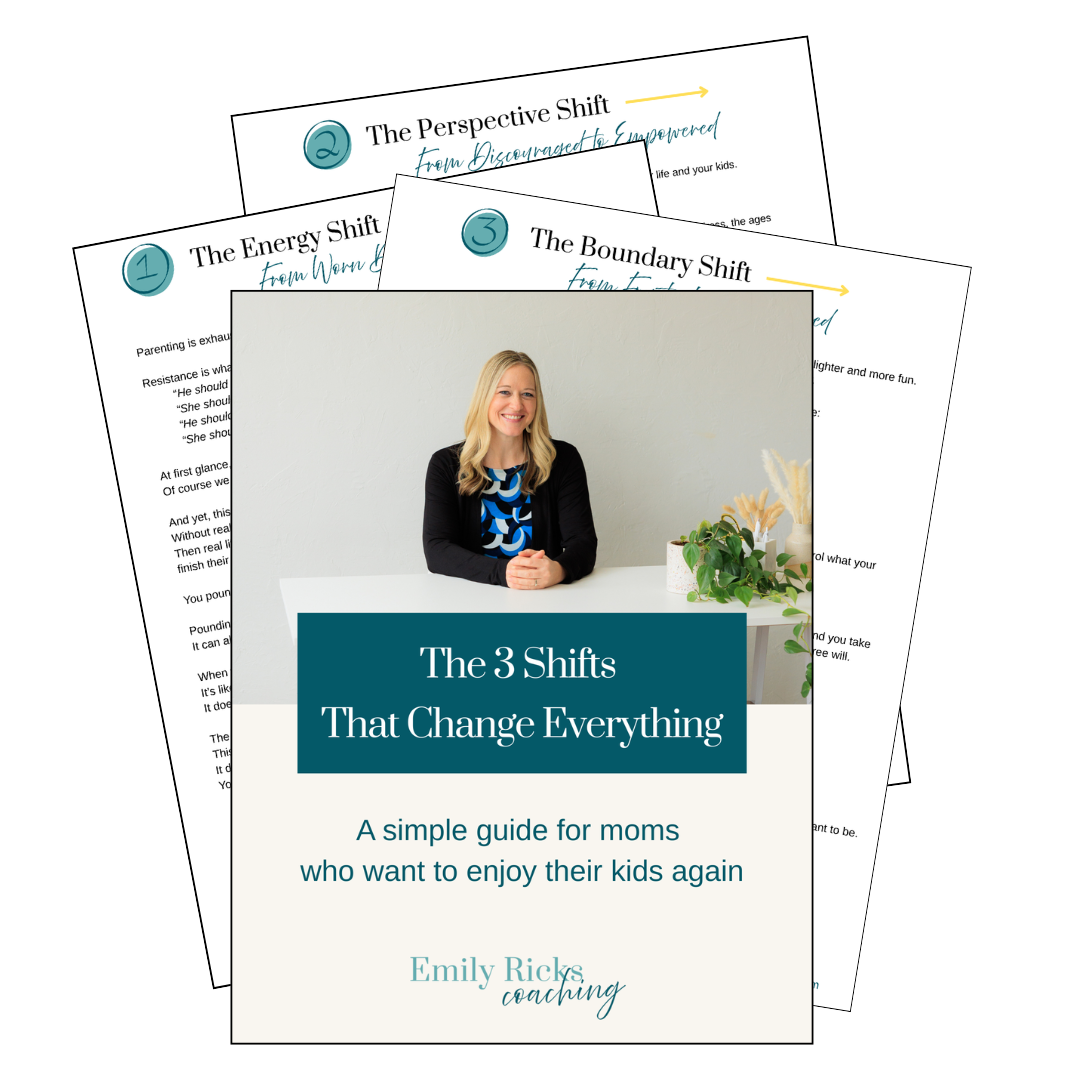
Download My Free Guide
The 3 Shifts
That Change Everything
Whether your kids are little, grown, or somewhere in between, this guide will help you move through discouragement and back to joy in your parenting
Full Transcript:
Ep 80-The Acceptance Paradox
You're listening to the Think New Thoughts Podcast with Emily Ricks, episode number 80, The Acceptance Paradox.
I'm Emily Ricks and this is Think New Thoughts, a life coaching podcast to help you find more joy in your relationships. In each episode, I'll share a simple idea that will help you see things in a new way so you can love God, your neighbor, and yourself more deeply than you ever have before.If you're ready to literally change your mind, I think you'll like it here.
Hey, how's it going? I want to start by letting you know that the final review of the podcast that I was hoping for before the end of February came through just in time. So shout out to Marl TT.
You're the hero. Thanks for your review. She said,
”Emily's messages are full of wisdom.They are shared in a clear and meaningful way, offering simple yet powerful examples that have helped me in ways I didn't expect. Somehow her words stay with me and I remember to apply them at just the right time.”
I am so glad to hear that.That is awesome. Thanks again for taking the time to write that review. I really appreciate it.
Okay. So last week we talked specifically about parenting and how you can feel tired because you've only gotten a few hours of sleep or hosted a birthday party or worked really hard at something, but you can also feel tired because of an additional layer of exhaustion that we create for ourselves when we operate from a state of resistance. Last week's episode focused on the heaviness and the frustration that we feel when we think our kids should be different than they are.
And today I want to talk about another way resistance wears us down. This isn't about resisting other people. It's resisting our own emotions.
So let's review the overarching idea. Resistance is arguing with reality. It's pushing against what is in this moment.
And it's fascinating because a lot of people believe the way to change something is to push against it. Like that kind of makes sense. There's a certain logic to that.
Even in my religious tradition, we sometimes say things like we need to resist temptation or we need to fight urges. Now I'm not suggesting we swing to the opposite extreme and just give in to every impulse. But what I've come to believe is that when we operate from resistance, when we push against reality, we use up a lot of energy that then can't be used to actually create change.
So let's talk about emotions for a minute, your own feelings. Let's say you're feeling resentful of
a responsibility on your plate. Maybe it's something in a church calling that's really time consuming.
Maybe it's something that you're doing for your kids. Maybe it's a request from your spouse. You are experiencing the feeling of resentment in your body.
Now here's what a lot of people do next. If you're someone who believes in scripture, you might think about Galatians five, where the fruits of the spirit are listed, love, joy, peace, patience, kindness, goodness, faithfulness, gentleness, self-control. And you know, you're not anywhere near that, right? So when you feel resentful, you might tell yourself, I shouldn't feel this.
I'm not supposed to feel this. I shouldn't feel resentful. I should feel patient and kind and willing to serve instead.
Now I want to ask you something. This is important to consider. If you've approached it that way, if you've tried that, if you'd like to tell yourself, I shouldn't feel that I shouldn't feel that.
Just tell me this, does it work when you tell yourself you shouldn't feel angry? You shouldn't feel resentful. You shouldn't feel critical. You shouldn't feel sad.
The saying that magically make the feeling disappear. If that works for you, go ahead and keep doing it in my experience. And in the experience of my clients, it doesn't actually work at all.
Usually when you tell yourself you shouldn't feel something that you're not supposed to feel something, you end up feeling worse because now you're resentful. And then on top of that, you feel guilty that you're resentful. You're frustrated.
And on top of that, you're now ashamed that you aren't feeling more loving. You start layering on more and more emotional weight. When you tell yourself you're not supposed to be feeling that way, but it's complicated because if you believe in the scriptures, and if you were taught to choose the right, and if you're trying to be gentle and loving the way Jesus was, then you know, when you're out of alignment with that.
And I think that's at the root of why we tell ourselves like, Oh, I shouldn't feel that way. I should feel this way. Something that has helped me a lot is separating should statements into two different categories, filtering them through two different sorts of machines.
The first is alignment. And the second is reality. So alignment has to do with your values, the kind of person you want to be, the things that you believe are right or wrong or good or bad.
So maybe you value honesty in relationships. So in that sense, you might say, I shouldn't lie. Maybe you value generosity.
And so you might say, well, I shouldn't be selfish. And these statements do make sense. And they are true in terms of alignment.
If I want to be aligned with my values, then I shouldn't be selfish. But I found that changing the wording just ever so slightly makes a huge difference. Instead of saying I shouldn't feel resentful, I might say I value gratitude.
And when I feel resentful, I'm not aligned with gratitude. Or instead of saying I shouldn't be critical of my kids, I might say I value focusing on things that are virtuous, lovely, and of good report. Like I believe in that.
And when I'm focusing on the worst and other people, I'm not aligned with what I actually value. And so to me, even though it sounds really similar to, I shouldn't be critical. It's just this simple difference that says when I am critical, that's not an alignment with who I want to be in the long run.
And when I talk like this, my values become a compass guide me toward who I ultimately want to become, but I'm not using them as a weapon to beat myself up every time I fall short of that. Okay. So that's alignment.
Now let's talk about reality. There's another category where should statements almost never make sense. They're not true.
That category is reality. If you're feeling resentful and you tell yourself, I shouldn't feel this, that's actually an argument with reality because the truth is your brain has already released chemicals that are creating this emotion in your body. You can't reverse it.
You can't hit the undo button. So telling yourself you shouldn't feel that way is like telling a river. It shouldn't flow downstream.
It's just an argument. You can never win. Fighting reality drains your energy.
Like if you're sick and you're sitting there thinking, I shouldn't be sick. I shouldn't be sick. I shouldn't be sick.
Like you already have your energy drained because of the sickness, but you're actually draining it even more with all the energy, trying to get the river to not flow downstream. The truth is if you've been exposed to a virus and your body is mounting an immune response, actually you should be sick. Your body is doing exactly what bodies do and arguing with the reality doesn't help you get better.
It actually takes additional energy away from you. It's the same thing. When we resist emotions, if you're telling yourself, I shouldn't feel angry, but you do feel angry.
Then the reality is, well, I feel angry. Now, acting in anger might not be aligned with your values. If you were to take action and do something really destructive or harmful, when you were angry, that wouldn't align with your values, but that's different than telling yourself, I shouldn't be feeling this way because the reality is that you are.
So here's where the acceptance paradox comes in. There's a powerful quote from Carl Rogers that captures this idea perfectly. He says, the curious paradox is that when I accept myself, just as I am, then I can change.
It almost sounds backwards. Doesn't it? Because a lot of times we believe change comes from fighting ourselves, from criticizing ourselves, from telling ourselves we shouldn't feel what we feel. But the reality is that resistance just drains our energy.
It doesn't create change. I like to think of this river. If the river is flowing downstream and you get in the water and you push against the water, you might feel like it's really productive.
Like you're getting a lot done because you're telling that river, no, you're supposed to flow the other way, but that's just going to make you tired. Real change actually begins with acceptance, which is okay. The river is flowing the way that it is.
And I can't change that at this point of the river here, but I could get out of the river. I could accept that it's flowing and maybe I could walk along the bank a mile and see what's happening a little further up. And then I could create change.
So acceptance isn't approval. It's not giving up, but it's an honest acknowledgement of what is true in this moment and understanding that no matter how hard I push against what's happening now, I can't actually change it. So instead of saying I shouldn't feel resentful, you might say, actually, I should feel resentful right now.
Based on the thoughts I'm thinking, my brain is producing chemicals that create this feeling. That's the reality. The river's flowing downstream.
That's exactly how it should be. And then when you're no longer resisting the emotion, you can start getting curious about it. You can ask, Oh, interesting.
So what are the thoughts that are creating this feeling? What are the beliefs that I'm holding? Your emotions have so much to teach you. If you can accept them and open up to them, they can show you what's happening inside of your mind, but you lose access to all of that information. When you press down the emotion and believe that you shouldn't be feeling it in this moment.
So here's something you can try next time you feel an emotion that doesn't align with who you want to be in the end. Instead of telling yourself, I shouldn't be feeling this. Try acknowledging it like, Oh, I feel resentful right now.
I feel angry about this. I feel critical. So you're not resisting it.
You're just being honest. You're just naming it. You're just acknowledging the feeling.
Sometimes we call that allowing emotion. And then you can check for alignment and you can ask yourself like, okay, is this aligned with the person that I want to be? Is this how I want to be
reacting and responding to this situation? What do I value here? Maybe you value kindness. Maybe you value gratitude.
Maybe you value patience. Maybe that's who you really want to be. And so your values can become a compass pointing forward, but you're not saying, Oh, I shouldn't be resentful.
I should be grateful. You're saying, okay, I value gratitude. And in the moment I'm feeling resentful, which doesn't align with what I value most.
And then you can start to get curious. I wonder why, what are the thoughts that are creating this emotion? Once you start looking at those thoughts and getting curious and open, it's like stepping out of the river, walking along the side, and then seeing what's going on further up. Once you can start to understand your thinking, then you can decide, okay, do I want to keep thinking these thoughts? Do I really believe these? Are these creating what I really want in my life? But acceptance is what opens the door to the possibility of change.
Resistance is like trying to push a river backwards. It's exhausting. It might feel productive, but it actually isn't.
Dr. Benjamin Hardy says you never change things by fighting the existing reality. Acceptance doesn't mean you like what's happening. It simply means you stop arguing with reality long enough to understand it.
And that's the paradox. When you shift out of resistance and into acceptance, that's when real change becomes possible. Try it out this week and see what you think.
Hey, if you enjoyed this episode and you've been feeling a little worn down in motherhood, I created something for you. It's called the three shifts that change everything. A simple guide for moms who want to enjoy their kids again, whether your kids are little grown or somewhere in between, this guide will take you from worn down to wise, from discouraged to empowered and from frustrated to anchored.
I'd love to share it with you. You can download it for free at EmilyRicksCoaching.com. And there's also a link in the show notes.
Thanks so much for joining me today! I'll talk to you next week.
Shownotes:
Feeling a little worn down as a parent?
Grab my free guide, The 3 Shifts That Change Everything.
A simple guide for moms who want to enjoy their kids again.
You’ll discover:
• The Energy Shift that moves you from worn down to wise
• The Perspective Shift that carries you from discouraged to empowered
• The Boundary Shift that takes you from frustrated to anchored
Ready for deeper support?
I offer 1:1 coaching for moms who are ready to experience these shifts in a deeper, more personal way. I’d love to help you renew your mind so you can enjoy your kids again.
