
Episode 86: The Art of Holding Space: Becoming Someone Your Teen Can Really Talk To
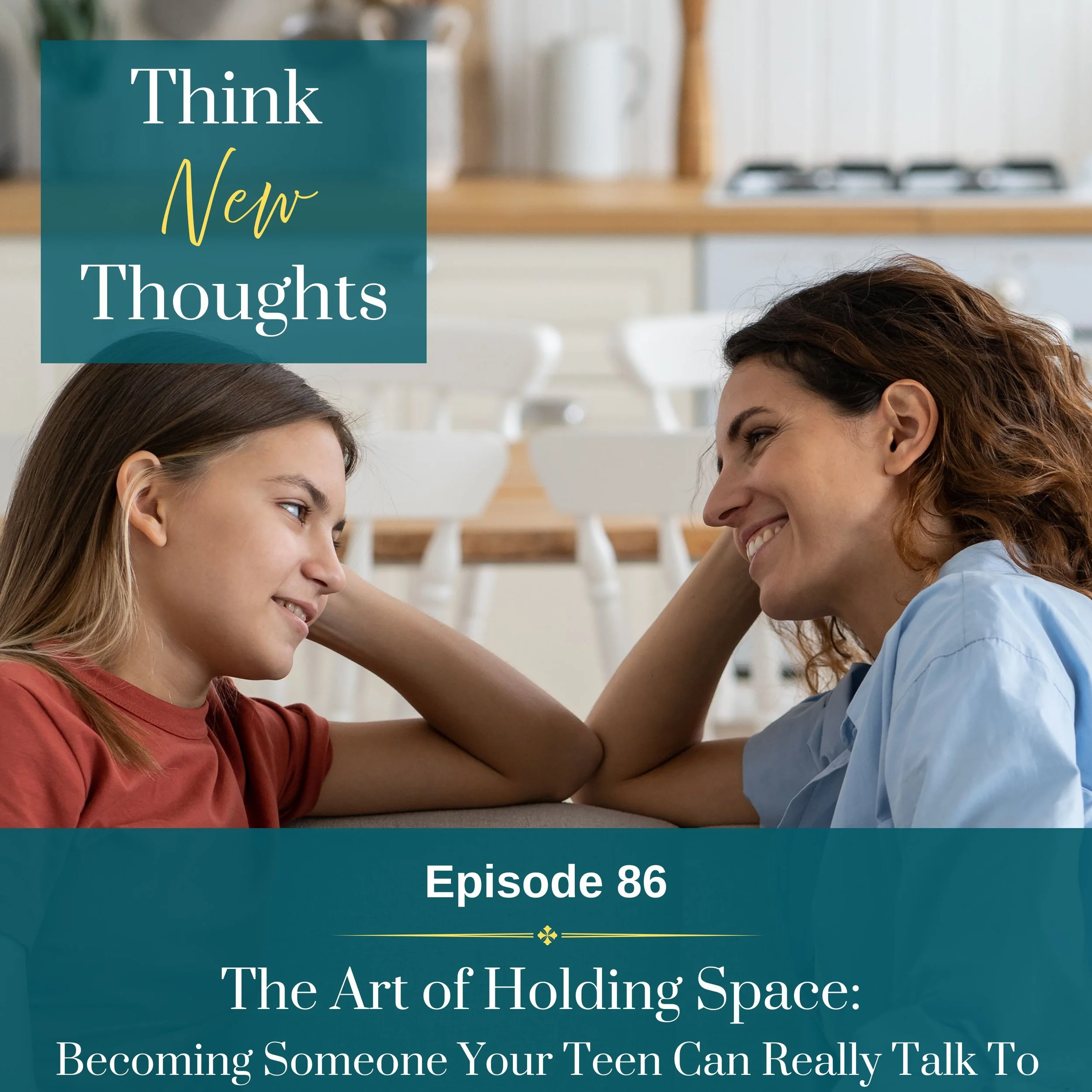
In this episode, I’m sharing a simple but powerful relationship skill that can completely change the way you connect with your teen: holding space. I’ll show you how to stay present without agreeing, fixing, or shutting them down—so your kids actually want to talk to you. If you’ve ever wondered how to become a safe place for your teenager, especially when conversations get hard, this is a skill you’ll come back to again and again—and one you can use in just about any relationship in your life.
Download My Free Guide
The 3 Shifts
That Change Everything
Whether your kids are little, grown, or somewhere in between, this guide will help you move through discouragement and back to joy in your parenting
Full Transcript:
You're listening to the Think New Thoughts Podcast with Emily Ricks Episode 86-The Art of Holding Space-Becoming Someone Your Teens CanReally Talk To
I'm Emily Ricks and this is Think New Thoughts, a life coaching podcast to help you find more joy in your relationships. In each episode, I'll share a simple idea that will help you see things in a new way so you can love God, your neighbor, and yourself more deeply than you ever have before. If you're ready to literally change your mind, I think you'll like it here.
Hey, how's it going? Today I want to share
with you a really powerful skill that is a total game changer in parenting.
The skill is called holding space. So let's talk about what it means to hold space and how you can
practice doing it more often in conversations. For this episode, I'm going to focus specifically on
how to hold space for teenagers and how that creates an environment where they are way more
likely to open up to you.
But of course you can use this skill with younger kids, with adult children, with your spouse,
coworkers, or really anyone in your life. So hopefully you can take what I'm sharing today and
apply it to the situations that will be most helpful for you. So what is holding space? It's a core
competency at the Life Coach School.
So in my coach training, we would submit videos of ourselves coaching clients, and we were
graded on how well we demonstrated certain skills. So as a coach, here's what holding spaces.
Coach does not agree with or believe the client's story while also not dismissing the client's lived
experience.
I love a good continuum to illustrate something. So here's one, we've got over on one side
agreeing with believing what somebody else is saying on one side of the continuum. And on the
other, we have disagreeing with them thinking that what they believe or think is wrong.
And neither one of those is holding space. Holding space is kind of this sweet spot in the middle.
So let's talk about the agreeing and the disagreeing.
And then we'll talk about what holding spaces. So when you agree with someone's story, it
means you take what they're thinking and feeling. And you say, yeah, you're totally right.
That's what I think too. That's what I feel too. And in coaching, we call that jumping into the pool.
So if a friend comes to and complains about how awful her sister-in-law is, you might be like, oh
yeah, that's so rude. And so you're agreeing with her story. She's telling you her thoughts about
her sister-in-law and you're now adopting those same thoughts.Yeah. I can't believe she said that she should have done that. So you agree and you jump into
the pool and now you're both swimming around in these negative thoughts about her sister-in-
law.
Or if your child comes to you and is feeling anxious about an upcoming test, jumping in the pool
would be saying, oh yeah, that's going to be so hard and scary. That'll probably be too much for
you. And you might start to feel anxious too.
Maybe you might want to excuse your child from the test so they don't have to feel worried about
it. And so now you've jumped in the pool and you're both swimming around together in anxiety
and fear. On the other side of the continuum, you can disagree with someone's story, with what
they're talking about.
So you might hear them say something and think, oh, that's really negative. I don't want to jump
in that pool and get all wet. So I'll just talk them out of all that.
So we can all be happy. And this is not jumping in the pool. This is dismissing what someone else
thinks or feels.
So dismissing usually sounds like, oh, don't be sad that he said that. I bet he was just joking or
what's not that big of a deal. You really shouldn't be so upset about it.
You can hear in those. It's like, you don't want the person to be thinking or feeling what they're
thinking or feeling. So you're trying to talk them out of it.
Or here's an example of dismissing. Oh my gosh. When my husband's father passed away, there
was a woman who came up to my mother-in-law shortly after his passing and said, well, buck up.
And that is a hilariously strong example of dismissing someone else's experience. And that is not
holding space. Okay.
So we have jumping in the pool on one side of the continuum, which is agreeing with someone's
story, with their thoughts, with their feelings. That's not holding space. If they hate something, you
hate it too.
If they're blaming someone, you say, yeah, it's their fault. You didn't do anything. If they feel
helpless and scared, you stand next to them and bite your fingernails too.
On the other side, dismissing what someone else thinks or feels and trying to talk them out of
their negative emotion. That's also not holding space. Holding space is allowing another person
to think and feel whatever they're thinking and feeling without judging any of it.
You don't jump in the pool and get all wet, but you also don't discount what they are experiencing.
You don't decide in that moment, if any of it is right or wrong, you just witness it. And I think it'sone of the most loving things you can do for another person.
And my observation is that most people rarely do this in their day-to-day relationships. So many
parents don't hold space for their kids. So many spouses don't hold space for their partner,
especially if they disagree about something.
Without realizing it, what usually happens is we bring our opinions into our relationship. So we
judge, we criticize, we lecture, we commiserate, or we try to steer or fix other people when we're
talking to them. And if you're holding space, you're observing a situation without judging it.
If you're not holding space, you're observing a situation and then filling the space with all of your
own opinions. So let me illustrate with two examples. Let's say my teenage son is talking about
an assignment at school that he doesn't really want to do.
And he says something like, ugh, I shouldn't even have to do it. It's so stupid. In that moment, I
get to decide how I want to show up.
So I could jump in the pool and say, yeah, that sounds so dumb. They shouldn't give you those
stupid assignments. That's a waste of your time.
And that would be agreeing with his story. And now I'm swimming around in his pool of frustration
and we're both wet. If I value education and I want my son to learn to work hard and speak
respectfully about others, I probably won't want to jump in the pool with him on this.
So if I don't want to jump in the pool, I might go to the other extreme and try to get him to be more
respectful and less entitled about the whole thing. If that's the case, I might dismiss his feelings
and say something like, we don't call things stupid in this house, young man. There are a lot of
people who work really hard to give you the opportunity to get an education.
And you better do that assignment if you want phone privileges this week. I know some people
who talk to their teenagers like this, and that's a great way to go if you want them to shut down
and stop sharing their honest opinions with you, or you can choose to hold space. When you hold
space, you can stay dry and your teen can stay open.
The conversation can stay open. So in this situation, holding space might look like me pulling up
a chair, sitting down and saying, Oh, interesting. Tell me why you think the assignment is stupid.
And he might say, well, I already know how to do it. It's just busy work for me to have to do these
two worksheets. And I might say, Oh, so you feel like it's busy work? And he might say, yeah, it's
a waste of time.
And I could respond with something like, okay, I see why it feels that way for you. And then I
might ask something like, how would you set up homework assignments if you were teaching this
class? And then I could let him vent, or I could let him share ideas. And in the end, I might ask aquestion like, interesting.
So do you think you're going to do the assignment or not? I could give him the power to make the
decision. And in this process, I'm fostering critical thinking. I'm modeling how to be respectful of
someone else's opinions.
I'm showing him that it's his life to live. It's his decisions to make, and also helping him maybe see
some of the trade-offs as he decides. But notice I haven't agreed with anything.
I haven't jumped into the pool and been like, yeah, homework is stupid. Because I don't actually
believe that. But I also haven't dismissed his concerns or tried to get him to see things my way.
That's what holding space is. Okay. Let me see if I can give you another example.
Let's say my daughter is complaining about a kid in her class that she finds annoying. I could
jump in the pool and say, oh, that is so annoying. I can see why no one likes him.
That's an option. That might help me feel some connection with my daughter because she'll
probably really like it if I agree with her, but that also doesn't feel very loving to her classmate.
And so that's not really how I want to show up.
If I jump in the pool, then I'll be all wet with judgment and negativity toward this guy in her class.
And that's not really who I want to be. On the other hand, maybe I'm feeling judgments of my
daughter coming up.
Like, gosh, why is she always so negative about her classmates? Maybe if I were a better mom,
she would have more positive things to say about her peers. I guess I haven't taught her very
well. If I fill this space with all those judgments, then I'm going to want to get her to stop saying
negative things.
Because right now that's going to feel really threatening to me. If she's complaining about school
and I'm making that mean that I'm a bad mom, then I'm going to need to get her to stop
complaining right now. So I'm going to try to steer the conversation away from all that negativity.
So if I have all those judgments and I'm feeling threatened by the stuff that she's saying, then I
might dismiss what she's saying to try to get her to stop. So I might say something like, well,
that's not very kind to talk about your classmate that way. Let's hear you say some nice things
about him.
And this might sound like I'm trying to be lovely, but what I'm actually saying is it's wrong of you to
judge him, but it's not wrong of me to judge you for judging him. And you need to stop. And this is
a great way to go.
If I want to shut my daughter down and if I want to get her to stop sharing her honest opinionswith me, since that's not what I want, I could choose to hold space for her in this conversation, not
jump in the pool and agree with her story and also not judge her story and dismiss it. Just be
open and curious. So in this situation, I could say something like, oh, it sounds like you really
don't like how he acts.
And she might say, well, yeah, he's so annoying. And I would hear what she has to say. And then
I might ask, what else does he say? That's frustrating for you.
I might ask, that's really interesting. Why do you think he's choosing to act this way? So I'm just
curious. I'm just open.
I don't have an agenda for the conversation. I don't need to steer it in a certain direction. If I set
my own judgments down, I can just be curious and open and find out what does my daughter
think and feel about this? And when I hold space in this way, I send the message to my daughter
that it's okay to be honest with me, that it's okay to share what you really think that I want to hear
your opinions.
And this is gold in a relationship with your teenager, because if they know you can hold space for
them to complain about an assignment or an annoying kid in class, they are much more likely to
trust you when their friend is harming themselves or doing drugs, or if they themselves get into
some trouble. When you hold space for someone, not agreeing with, and also not disagreeing
with their viewpoints, you show that you're a safe space. You are a person who can handle the
truth without freaking out.
A lot of teenagers don't open up because they're afraid. They're afraid of being punished. They're
afraid of being yelled at.
They're afraid of being misunderstood. Maybe they're afraid of disappointing us. And a lot of
times they're afraid of being judged.
I get that. I don't love being judged either. When you hold space, when you're able to have
conversations where you can be genuinely interested in what they think without having to agree
or disagree, you make it so much more likely that your teens will feel safe talking to you about
hard things.
That's what's so powerful about this skill. So see if you can have a conversation with one of your
kids this week or someone else in your life, if you'd like, where you don't judge them just for 10 or
15 minutes. See if you can set your own opinions aside of what you think they should do or who
they should be friends with or how they should react to something that's going on at school.
See if you can just listen and provide a space that's free of your own opinions for just a few
minutes for them to share what they're experiencing. And this isn't just keeping your mouth shut
about your opinions. It's actually choosing to detach from them and just be open and curiousabout what your kids are experiencing.
Just find out more of what they're thinking and feeling. Leave your own opinions out of the
conversation for a few minutes. Honestly, this is one of the most powerful skills I know of to
connect with teenagers.
It's amazing how they shut down when they feel judged and how they open up when they feel
seen and heard. And when they trust you're not trying to fix them or control them or manipulate
them or get them to think in a certain way. You're just genuinely interested in what they think and
what they feel.
Okay. So that's holding space. It's a magical skill.
Give it a try this week and see what you think.
Hey, if you enjoyed this episode and you've been feeling a little
worn down in motherhood, I created something for you.
It's called the three shifts that change everything. A simple guide for moms who want to enjoy
their kids again. Whether your kids are little, grown, or somewhere in between, this guide will
take you from worn down to wise, from discouraged to empowered, and from frustrated to
anchored. I'd love to share it with you. You can download it for free at Emilyrickscoaching.com. And there's
also a link in the show notes. Thanks so much for joining me today! I'll talk to you next week.
Shownotes:
Feeling a little worn down as a parent?
Grab my free guide, The 3 Shifts That Change Everything.
A simple guide for moms who want to enjoy their kids again.
You’ll discover:
• The Energy Shift that moves you from worn down to wise
• The Perspective Shift that carries you from discouraged to empowered
• The Boundary Shift that takes you from frustrated to anchored
Ready for deeper support?
I offer 1:1 coaching for moms who are ready to experience these shifts in a deeper, more personal way. I’d love to help you renew your mind so you can enjoy your kids again.
