
Episode 87: The Art of Holding Space Part 2 // Witnessing Yourself Without Judgment
In this episode, we’re building on last week’s conversation about holding space for your kids and turning that same practice inward. I’ll show you what it looks like to hold space for yourself when you’re feeling overwhelmed or stuck, and why most of us tend to either coddle or criticize instead. We’ll talk about a gentler, more powerful option—and why learning to hold space for yourself is one of the kindest things you can do for yourself and everyone in your family.
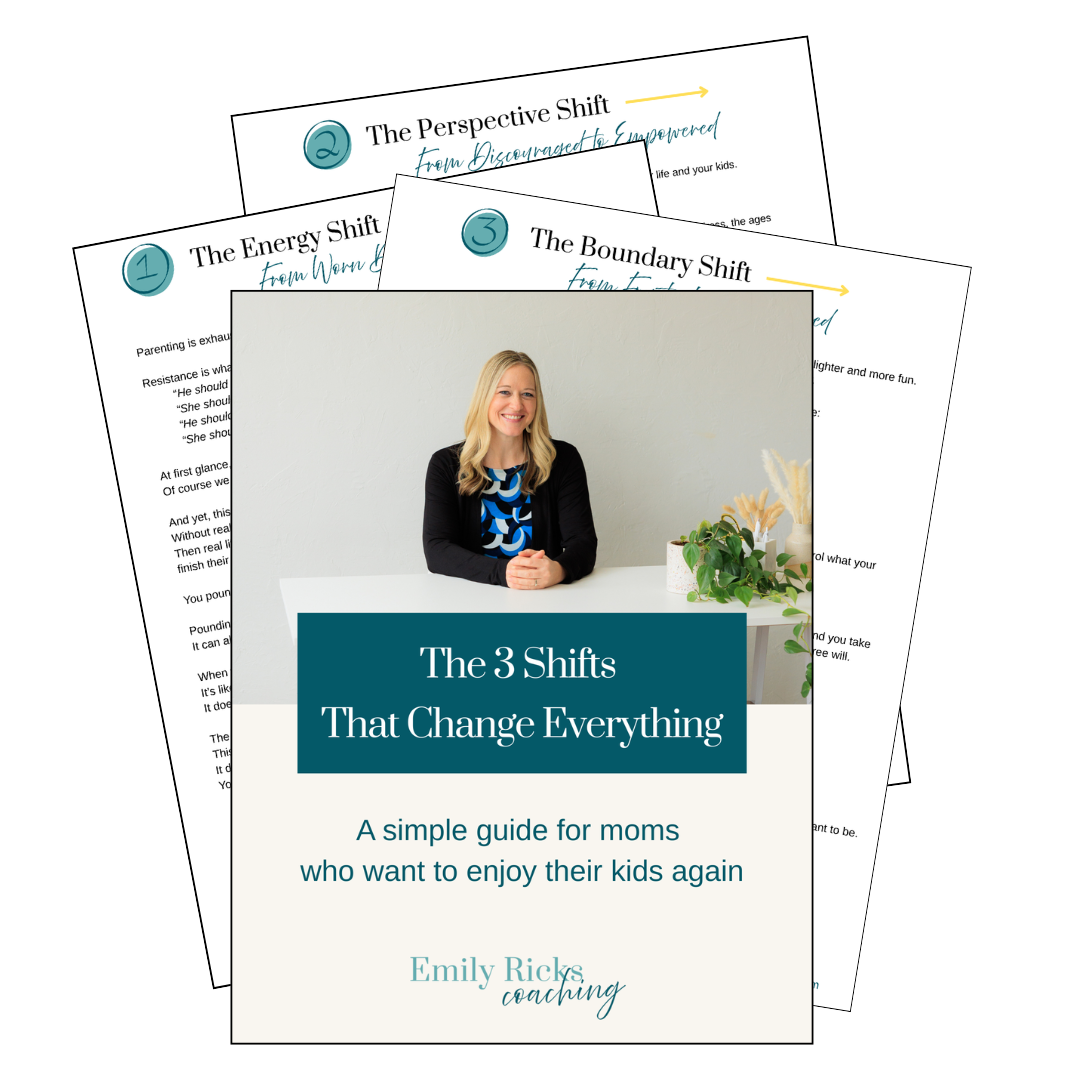
Download My Free Guide
The 3 Shifts
That Change Everything
Whether your kids are little, grown, or somewhere in between, this guide will help you move through discouragement and back to joy in your parenting
Full Transcript:
You're listening to the Think New Thoughts Podcast with Emily Ricks episode number 87, The Art of Holding Space, Part 2, Witnessing Yourself Without Judgment.
I'm Emily Ricks and this is Think New Thoughts, a life coaching podcast to help you find more joy in your relationships. In each episode, I'll share a simple idea that will help you see things in a new way so you can love God, your neighbor, and yourself more deeply than you ever have before. If you're ready to literally change your mind, I think you'll like it here.
Hello, welcome back to Think
New Thoughts. Last week we talked about holding space for your teenagers and how that means
not jumping in the pool and agreeing with everything they say, especially when they're frustrated
or upset, but also not dismissing their viewpoints and trying to get them to be more positive or
more respectful.
Today I want to dive into holding space a little bit more and talk about how you can hold space for
yourself, what that looks like, and why it matters so much. So just to review from last week,
holding space is not agreeing with someone else's story and also not disagreeing or trying to talk
them out of what they feel. So instead of judging their viewpoint as right or wrong or positive or
negative, when you hold space, you just witness what they're experiencing with curiosity and
without judgment.
You don't fill this space with your opinions. You hold a space that is free of your opinions. I almost
think of it like a force field that is protecting that space so that the opinions don't come into it.
And this is a discipline. It takes intention to create that kind of space. It's kind of like keeping your
family room tidy.
If you just let things happen, then you're going to end up with dirty socks and backpacks and toys
and food and books and all sorts of stuff filling the room. And same thing, if you just let your
conversations run wild, if you just let your mind run wild, then it's going to get cluttered up with all
of your opinions. But there is tremendous value in taking time to tidy up and create a space in
your mind that is free from all of your judgments.
So I have a question for you. Do you hold space for yourself? When you are frustrated or sad or
feeling hurt, how do you show up for yourself? I see three main ways that women tend to treat
themselves when they're feeling negative emotion. There's coddling, cuddling, and criticizing.
So let's talk about all three. Coddling is when you show up for yourself by feeling sorry for
yourself. And you think things like, oh, you poor thing.
This is so unfair. This is really hard. I shouldn't have to deal with this.The world is awful and scary and I'm the victim. That's coddling. So maybe you sometimes coddle
yourself when you're struggling.
And it kind of seems loving, like you're honoring your own pain when you say, oh, this is the
worst. All these horrible things are always happening to me. But my experience is that it actually
isn't the most loving way to treat yourself.
If you have a victim story where you are powerless and helpless and you coddle yourself and
jump in the pool and agree with all those negative thoughts, then you perpetuate this story that
keeps you as the victim. When you're the victim and everything's happening to you, then you shut
yourself off from claiming your power in a situation. You keep yourself from developing the
patience and the faith and resilience that you could step into if you believe that things are
happening for you and for your growth.
And you would feel much more empowered if you were believing that. So coddling is agreeing
with your negative thoughts. If you have a thought that life is unfair, then coddling yourself is
saying, yeah, life is so unfair.
Let's dwell on that. Let's marinate in that self-pity. And here's why this is a tempting way to go,
because it feels good to prove yourself right.
That's one reason why people coddle themselves. Also, it gives you a bunch of reasons why you
don't need to change. Because if nothing is your fault, if nothing is in your control, if other people
are the reason that you're unhappy, then that gives you all the excuses to not do anything.
So coddling is an option. It makes sense why we sometimes choose it, but it's not holding space
for yourself because it's agreeing with all the negative thoughts you have about what's going on in
your life. So if you don't want to coddle yourself, you might decide to criticize your own negative
thoughts.
So this is like last week when I was sharing the example of my teenage daughter. If she's
complaining about someone at school and she's being negative about them, then I could judge
her for judging her classmate and say, well, you shouldn't do that. You shouldn't judge him.
And you can do that to yourself too. If you're feeling angry, for example, you can judge yourself
and you can say, oh, it's wrong to feel angry. I shouldn't feel angry.
I shouldn't be upset. I shouldn't be resentful. And then you can shut yourself down and try to
press it all down to get it to go away.
So that's a way of dismissing yourself. It's criticizing yourself for what you feel, telling yourself that
it's bad or wrong to feel that way. And this is not holding space.
And I will say for me, I don't believe this is a kind way to treat myself. I don't feel kind when I talkto myself in this way, when I dismiss myself and criticize myself. So instead of coddling or
criticizing, you can hold space.
And I love to think of this as cuddling, not coddling, cuddling. Cuddling is, Hey, I can see that you
are sad or mad or disappointed or confused. And that is totally okay.
I'm here. I'm with you in this. Tell me what this is like for you.
I want to understand what you're experiencing here. I want to give you a hug. And it's so
powerful.
Cuddling, not coddling, not criticizing, not judging yourself. That's what it means to hold space. So
what do you usually do for yourself when you're feeling upset? Can you think of some times when
you've coddled yourself and agreed with your own negativity? So you can prove yourself, right?
Or can you think of some times when you have criticized yourself to try to press it down? You've
judged what you're feeling is bad or wrong.
I shouldn't be like this. I shouldn't think like this. I should be better.
What would it be like if you could hold space for yourself sometimes to just be present and allow
yourself to think and feel whatever you think and feel? To notice it, but not agree with it and not
judge it, but just see it and begin to understand it. What would it be like if you could have
conversations with your kids, where you just heard them and saw them, where you didn't coddle
them with pity, but you also didn't criticize what they're saying, but you could just listen. I think this
is such a gift, a gift you give to yourself, but that also extends to your whole family and to
everyone in your life.
Because the better you get at holding space for yourself, the more and more you will be able to
do that for others. If you want to get better at holding space for yourself, if you like this idea of not
coddling yourself and agreeing with all of your negative thoughts, but also not criticizing yourself
and pushing away all the negativity, here's a place to start. The next time you're feeling stressed
or overwhelmed or resentful or any other negative emotion, try this.
Set a timer for 10 minutes and sit down and write all of your thoughts down on a piece of paper.
You could type it up too, but don't try to do it in your head. Don't just let your thoughts spin around
and around inside your mind.
This won't work if you do that. Write down your thoughts and you're not going to censor, you're
not going to filter, you're not going to be like, oh, I shouldn't think that, I shouldn't write that down.
Just write down everything that's going on in your mind.
Then until the timer goes off, just notice what you wrote. Like, oh, I'm just noticing right now. I'm
not judging it, I'm just noticing.And if you find that you are judging your thoughts as bad or wrong, then just notice that. Oh,
that's interesting. I noticed that I'm judging my thoughts.
That's okay. I'm just sitting with all my thoughts right now. I can just sit with these right now.
If 10 minutes is too long, do it for five, but just try it. A lot of times when we witness our own
negativity, we want to run from it. We want to fix it.
We want to change it. When you choose to hold space and not judge it, but just sit with it, you
can come to understand it. And when you understand what you feel, that's an incredible
experience to feel seen and to feel understood by yourself.
It's so powerful. And when you feel seen and understood, then you can see clearly to decide what
you want to do next. And then you can move through the emotion instead of feeling like you need
to run away from it.
This is such a beautiful gift you can give yourself to witness your thoughts and not judge them. Or
to judge your thoughts and not judge yourself for judging, but just to witness yourself, your own
thinking and say, oh, that's interesting. I noticed that I'm judging my frustration as wrong to feel.
That's so fascinating. Isn't this interesting? The more you do this with yourself, the more you will
be able to do it with others. And to give someone a space, a space where they aren't judged, but
they're just held, I think is one of the most loving things you can do.
Give it a try this week and see what you think.
Hey, if you enjoyed this episode and you've been feeling a little
worn down in motherhood, I created something for you.
It's called the three shifts that change everything. A simple guide for moms who want to enjoy
their kids again. Whether your kids are little, grown, or somewhere in between, this guide will
take you from worn down to wise, from discouraged to empowered, and from frustrated to
anchored. I'd love to share it with you. You can download it for free at Emilyrickscoaching.com. And there's
also a link in the show notes. Thanks so much for joining me today! I'll talk to you next week.
Shownotes:
Feeling a little worn down as a parent?
Grab my free guide, The 3 Shifts That Change Everything.
A simple guide for moms who want to enjoy their kids again.
You’ll discover:
• The Energy Shift that moves you from worn down to wise
• The Perspective Shift that carries you from discouraged to empowered
• The Boundary Shift that takes you from frustrated to anchored
Ready for deeper support?
I offer 1:1 coaching for moms who are ready to experience these shifts in a deeper, more personal way. I’d love to help you renew your mind so you can enjoy your kids again.
