
Episode 88: The Invisible Barrier Between You and Your Kids—And How to Move Through It
If you deeply love your kids and want to enjoy and connect with them more, but you also feel unseen or unappreciated as a mom sometimes, this episode is for you. I’m sharing the surprising reason feeling unappreciated can make connection harder—and the mindset shift that can help you feel more emotionally available, joyful, and connected with your family again. You’ll learn how to stop depending on your kids to create appreciation for you and start creating it from the inside out.
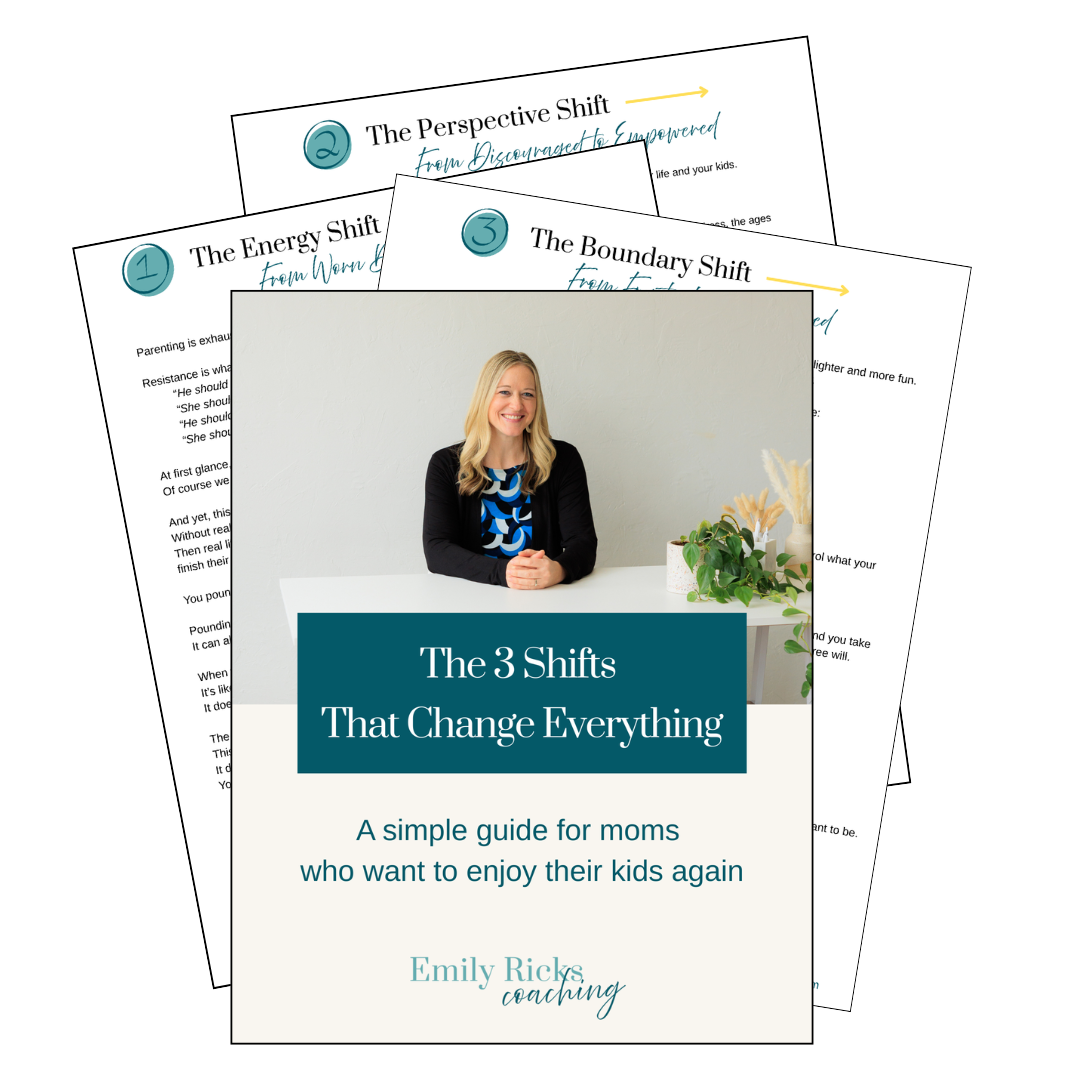
Download My Free Guide
The 3 Shifts
That Change Everything
Whether your kids are little, grown, or somewhere in between, this guide will help you move through discouragement and back to joy in your parenting
Full Transcript:
You're listening to the Think New Thoughts Podcast with Emily Ricks episode number 88, The Invisible Barrier Between You and Your Kids—And How to Move Through It
I'm Emily Ricks and this is Think New Thoughts, a life coaching podcast to help you find more joy in your relationships. In each episode, I'll share a simple idea that will help you see things in a new way so you can love God, your neighbor, and yourself more deeply than you ever have before. If you're ready to literally change your mind, I think you'll like it here.
88-The Invisible Barrier Between You and Your Kids
Transcribed by TurboScribe. Go Unlimited to remove this message.
You're listening to the Think New Thoughts Podcast with Emily Ricks, episode number 88. The
invisible barrier between you and your kids and how to move through it. I'm Emily Ricks and this
is Think New Thoughts, a life coaching podcast to help you find more joy in your relationships.
In each episode, I'll share a simple idea that will help you see things in a new way so you can
love God, your neighbor, and yourself more deeply than you ever have before. If you're ready to
literally change your mind, I think you'll like it here. Hello, and welcome back to Think New
Thoughts.
If you're listening today, I'm guessing you deeply love your kids and truly want to enjoy and
connect with them more. But when you're carrying the mental load of motherhood and doing the
thousands of things that you do to take care of your kids, it's easy to start feeling unseen and
unappreciated. And when you don't feel seen and appreciated, that actually makes it hard to want
to connect with your kids.
You may find yourself believing the reason you feel this way is because your kids aren't helping
enough. They're not noticing enough or appreciating you enough. But in this episode, I'm gonna
show you why that belief actually keeps you stuck and show you how you can feel more
appreciated, supported, and emotionally available, even if your kids don't magically start thanking
you for your efforts 15 times a day.
So let's dive in. Have you ever seen the movie Groundhog Day? It's the one where Bill Murray
plays Phil Connors, a news anchor who gets stuck in the same day over and over on February
2nd. So he's in Punxsutawney, a little town in Pennsylvania, repeating this day again and again.
And one time he passes a tree where a kid is climbing and the kid falls out of the tree. So
eventually Phil starts passing by this tree on purpose at the same time every day, catching the kid
who falls because he knows it's gonna happen. And it's hilarious.
One time they show Phil catching the kid and then the kid just steps out of his arms and walks
away. And Phil holds his lower back in pain. And he says, you little brat, you have never thanked
me.
Have you ever felt like that as a mom? Like you run around all day catching your kids as they fall
out of these metaphorical trees and they don't even realize a fraction of what you were doing for
them day after day. We had a really great discussion recently on Mother's Day in my women's
group at church, where we listed on the board a bunch of different verbs of the things that moms
do. Here are some of the ones we came up with.
Loving, encouraging, organizing, celebrating, nourishing, guiding, noticing, accepting, forgiving,praying, teaching, listening, asking, reminding, advocating, driving, cleaning. And the list goes on
and on. There are probably thousands more.
Hopefully on Mother's Day, you got some hugs, maybe some notes, or maybe some I love you
moms that helped you to feel appreciated. I love that there's a day dedicated to pausing and
noticing and thanking moms for what they do. But maybe you didn't get that on Mother's Day.
Or even if you did, what about the other 364 days of the year? What about real life when your
kids are looking not very enthusiastic to eat the dinner that you made, or they're rejecting advice
you're trying to give them, or they're waiting until the 17th time you ask to finally put their shoes
away? It's very easy to end up feeling unappreciated as a mom. And if what you want is
meaningful connection, then actually feeling unappreciated is gonna sabotage that. If you've been
with me a while, you already know the CTFAR model, but let's just review it for a second.
Circumstance, thought, feeling, action, result. And circumstances are neutral, thoughts create
feelings, feelings drive actions, and actions produce results. So let's take a closer look at what
happens when you as a mom feel unappreciated, okay? So if unappreciated is on the feeling line
of the model, what actions flow from this feeling? Like if I had a camera on you, what would I see
you doing or not doing when you're interacting with your family when you feel unappreciated?
You might get snarky.
Maybe you nag or criticize. Maybe you complain out loud or in your mind. Maybe for you, when
you feel unappreciated, you sigh or you stomp around.
Maybe you drop hints of what you want people to do or say, and then you get more and more
frustrated when they don't actually do it. And maybe eventually you end up exploding and you say
something like, oh, I'm so tired of you guys leaving all your stuff around. Can you just pick it up?
Whatever it looks like for you, here's my guess.
When you are snarky or critical or nagging or stomping around or being passive aggressive or
exploding, I'm pretty sure that your kids don't come up to you and say, wow, mom, looks like
you've got a lot on your plate. I can see beneath your anger and resentment and snarky
comments that what you really need is a hug. And for us to pitch in around the house and say,
thank you for everything you do.
Thanks, mom. We love you. Probably not what your kids say.
What's more common is for kids to respond by avoiding you because you seem upset or arguing
back or making excuses to defend themselves against what they feel like is an attack or maybe
they just emotionally withdraw. So here's kind of how this works. You clean and cook and drive
and organize and help and listen.
And your kids don't appreciate you in the way that you think they should. And so you think theyshould appreciate me. They should say thank you more.
They should realize how much I'm doing. And so you have your own groundhog day moment
where you're like, you brat, you have never thanked me. And then you feel unappreciated.
And from that feeling, you show up with negative energy and your kids respond negatively too.
And the result is you don't end up with meaningful connection. Maybe you avoid each other.
Maybe you argue, maybe you get a little help with the dishes or cleaning up or whatever it was
that you were wanting. But then as soon as they do the thing you asked, they slip away so you
can't make any more demands. And then you feel very unappreciated and even more
disconnected.
So here's the important part that I wanna point out. In your mind, the problem is my kids don't
appreciate me. That's why I feel so disconnected.
But let me offer you another way to think about this. The coaching principle I teach is that
thoughts create feelings, but your brain by default will tell you that other people's actions create
your feelings. So that sounds like if my kids say thank you and help without being asked, then I'll
feel appreciated.
If they don't say thank you, or if I have to nag and remind to get their help, then I'll feel
unappreciated. We attribute how we feel to what our kids did or didn't do. But the truth is your
thoughts create your feelings.
And I don't say that to accuse you, I say it to free you. Because if you believe that your feelings
are created by your kids' actions, the only time you can be happy is when they do exactly what
you want them to do. The rest of the time you have to be miserable.
When you think this way, you're essentially handing your emotional remote control over to your
kids. And you're saying, okay, I need you to push this button right here. I need you to say thank
you for all the things I do.
And then I'll feel appreciated. And then I'll wanna connect with you. And as you hand them your
remote, you're also saying, if you don't push this button like I asked you to, then I'm gonna feel
overwhelmed and overlooked and unappreciated and grumpy, and I'm not gonna wanna connect
with you.
But do you see how that gives your kids an enormous amount of power over your emotional life?
Don't do this to yourself. And don't do it to your kids. It's not good for anyone involved.
Take back your remote control. Take ownership that you are creating how you feel by what you
think. So I want you to imagine for a second that you already feel deeply appreciated, seen, and
valued as a mom.If you really felt that, how would you show up with your family? Usually when we feel appreciated,
we wanna go the extra mile. We put in even more effort because it feels good to do that. We
enjoy being generous.
We feel connected. We want to spend time with people. Those are the natural actions that flow
from feeling appreciated.
So you can see how valuable that feeling is if what you really want is connection. So what if you
could create that feeling yourself instead of waiting for your kids to create it for you? Did you
know you can? I wanna share two simple ways you can create appreciation internally without
depending on your kids to create it for you, which means you'll be able to stop resenting them
when they don't. Okay, here's the first way.
You can intentionally think appreciative thoughts about yourself. You might literally say, huh,
Emily, thank you so much for sweeping and mopping the floor. It feels so nice in the kitchen now.
Or hey, self, I really appreciate that you planned out those meals and got the refrigerator stocked
with everything you need to make dinner for the next several days. If you're skeptical about doing
this, talking to yourself like this, I dare you to try it out loud or just in your own mind and see how
you feel when you choose to appreciate yourself. Pay attention to how you feel when you notice
the things you do each day and say thank you for some of them.
Hey, self, thanks for decluttering the laundry room closet and donating winter boots that don't fit
anyone. Hey, self, great job teaching those kids how to read and walk and talk. That's pretty cool.
They can write essays now and do flips on the trampoline. Way to go. Because here's the thing,
your kids probably won't fully appreciate what you do for them until they are parents and they're
the ones doing it.
Or maybe they will never fully appreciate you, but you know how hard you work. You know the
effort. So take opportunities to tell yourself thank you for the beautiful life that you're creating for
your family and see how you feel when you do that.
Another button that you can push on your own emotional remote control if you want that
wonderful feeling of appreciation is you can appreciate other moms. Next time you're feeling
unappreciated, try this. Think about other moms and notice in your mind the things that they do.
Think about the moms in your neighborhood who also change diapers or do dishes or clean up
throw up and just appreciate that they continue to do it every day. Isn't it amazing? I remember
when my oldest was about six months old, we went to a stadium for a big soccer game and I
looked around at all the people and thought every single one of these humans in this stadium had
a mom who was pregnant with them. And they had someone who got up in the night and
changed their diapers and fed them round the clock.I never realized how much work it was until I had my own baby. And so when I saw all of these
humans, I went, wow, look at all the effort that this stadium full of people represents. And I felt an
appreciation for moms all over the world.
When you feel unappreciated, try appreciating your own mom and the things she provided for you
and sacrificed for you. And then notice how you feel when you think these thoughts. You will feel
appreciation in your body.
And appreciation is a very abundant, rich, joyful feeling. It feels really good. So when you
generate that emotion by the way you think and by what you choose to focus on, then instead of
feeling distant and cold and resentful and snarky with your family, you will be able to be
connected and kind.
And you might still ask for help around the house or with whatever it is, but you won't do that by
yelling or nagging or manipulating because those aren't the actions that naturally flow from a
feeling of appreciation. And gratitude breeds more gratitude. So the more you create it inside of
you with your thoughts and fill your home with gratitude, the more and more of it you will begin to
experience.
So imagine your emotional remote control. You're not handing it over to your kids and saying, I
need you to notice and thank me for the things I do so I can feel appreciated. You're holding it in
your own hand and saying, I can generate the gratitude and appreciation that I want to feel.
And when I do that, connecting with my kids and genuinely enjoying them will be so much easier
to do. Instead of feeling unseen and unappreciated and then trying to make yourself spend
quality time with your kids because you're supposed to, when you intentionally generate a feeling
of appreciation inside of yourself, connection will feel very natural, effortless even. You want to
connect when you feel appreciation.
And this might seem backwards to you, but I promise you it works and it's magical. So instead of
waiting for appreciation from your kids or anyone else in your life for that matter, put your
emotional remote control back in your own hands and generate that feeling with your own
thoughts. When you notice frustration or resentment this week, see if you can gently redirect to a
thought of appreciation.
Just one, a thought like, I appreciate the things I do for my family or I appreciate other moms who
work so hard every day. And then notice how when you shift out of feeling unappreciated into
appreciating others, your actions become kinder. Your ability to authentically connect with your
kids increases.
Cheering you on as you try on this new way of thinking this week and wishing you meaningful,
joyful connection with your family as a result.
Hey, if you enjoyed this episode and you've been feeling a little
worn down in motherhood, I created something for you.
It's called the three shifts that change everything. A simple guide for moms who want to enjoy
their kids again. Whether your kids are little, grown, or somewhere in between, this guide will
take you from worn down to wise, from discouraged to empowered, and from frustrated to
anchored. I'd love to share it with you. You can download it for free at Emilyrickscoaching.com. And there's
also a link in the show notes. Thanks so much for joining me today! I'll talk to you next week.
Shownotes:
Feeling a little worn down as a parent?
Grab my free guide, The 3 Shifts That Change Everything.
A simple guide for moms who want to enjoy their kids again.
You’ll discover:
• The Energy Shift that moves you from worn down to wise
• The Perspective Shift that carries you from discouraged to empowered
• The Boundary Shift that takes you from frustrated to anchored
Ready for deeper support?
I offer 1:1 coaching for moms who are ready to experience these shifts in a deeper, more personal way. I’d love to help you renew your mind so you can enjoy your kids again.
