
Episode 89: The Hidden Contract That’s Making You Miserable as a Mom
You might not realize it, but there’s something quietly shaping how you show up as a mom every day—and it’s probably making you more frustrated, more exhausted, and more stuck than you need to be. In this episode, I’m talking about the “hidden contract” so many of us are unknowingly living by, how it forms, and why it keeps you feeling miserable even when you’re trying so hard to do everything right. And then I’ll show you a simpler, more freeing way to think and relate to your kids that can change everything about how you experience motherhood.
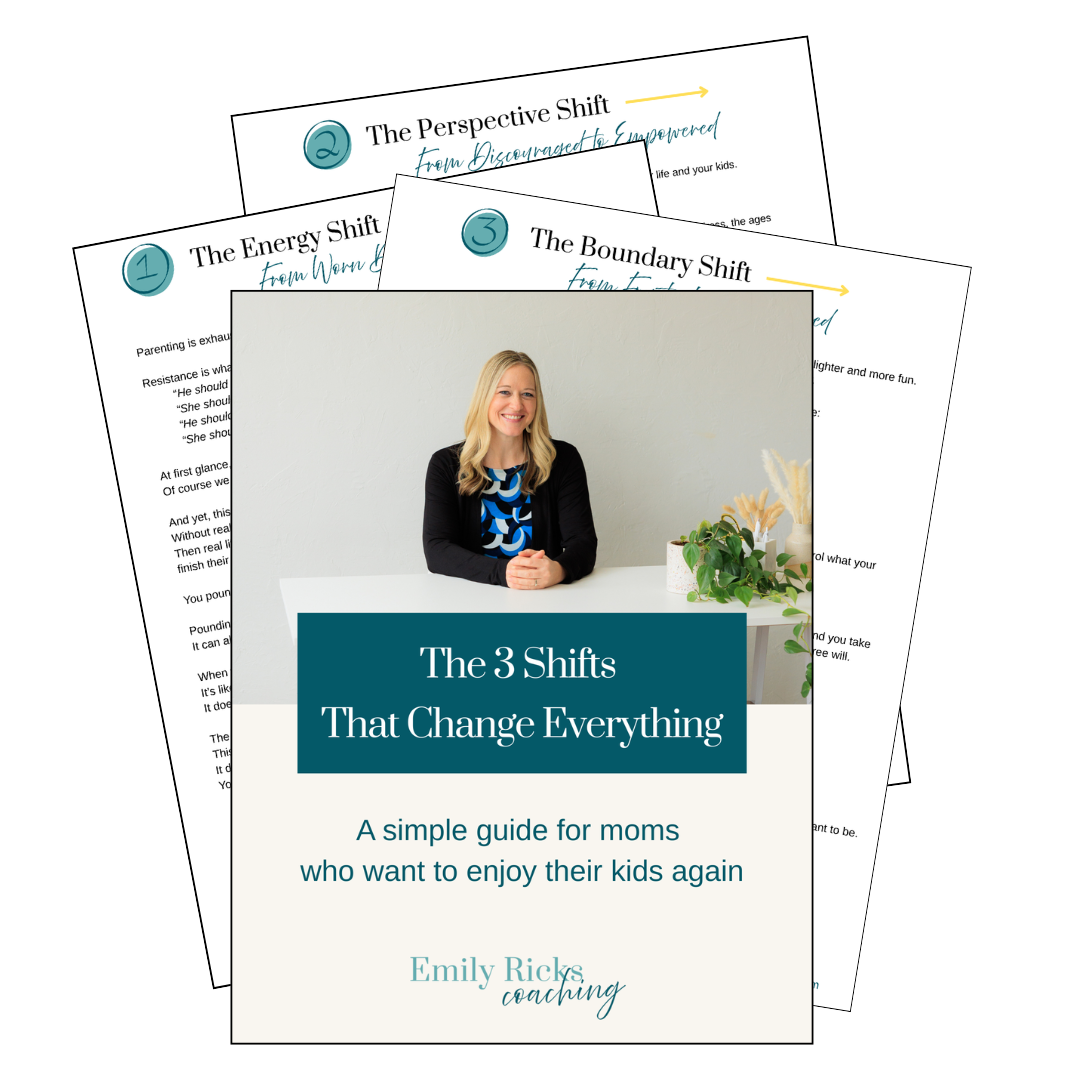
Download My Free Guide
The 3 Shifts
That Change Everything
Whether your kids are little, grown, or somewhere in between, this guide will help you move through discouragement and back to joy in your parenting
Full Transcript:
You're listening to the Think New Thoughts Podcast with Emily Ricks episode number 89, The Hidden Contract That’s Making You Miserable as Mom
I'm Emily Ricks and this is Think New Thoughts, a life coaching podcast to help you find more joy in your relationships. In each episode, I'll share a simple idea that will help you see things in a new way so you can love God, your neighbor, and yourself more deeply than you ever have before. If you're ready to literally change your mind, I think you'll like it here.
Hey, welcome to Think New Thoughts.
I'm Emily Ricks, and today we're talking about something that you're probably doing that you don't
realize you're doing that's making you miserable as a mom. It has to do with hidden contracts. So
today I'm going to explain what those are, why creating them makes you miserable, and then I'll
show you a different way you can choose to if you want to not be miserable and enjoy your kids
more.
So to start, let's talk about regular contracts for a minute. Think about a mortgage on a home.
When you sign the contract, there are terms and conditions.
The agreement is pretty simple. You make the payments, and you get to continue living in and
owning the home. If you stop making payments for long enough, eventually the bank can
repossess the house.
Those are the conditions. But notice something interesting. The terms and conditions are not
about feelings.
There's nothing in the contract that says, and if you miss your payment, the bank president will be
really upset and call you to lecture you about your financial choices. There's nothing in there
about disappointment, or guilt trips, or anger, or any kind of emotional drama. The contract just
says, if you make the monthly payment, you get to own the house, and if you don't, the bank is
going to take ownership back.
Those are terms and conditions. Or let's say my son is going to mow my neighbor's lawn this
summer. The agreement is if he mows the lawn, he'll get paid 30 bucks.
If he doesn't mow the lawn, he doesn't get paid. It's pretty straightforward. And there's no clause
in that little agreement that says, if you don't mow the lawn, Mrs. Johnson now has to spend the
next three days worrying about your future and questioning your character and replaying this over
and over in her mind.
No, it's just mow the lawn, get paid. Don't mow the lawn, don't get paid. So that's the idea of
terms and conditions in a contract.So here's the thing. As moms, we create these invisible contracts in our heads, and we set terms
and conditions on our own emotions based on what our kids choose to do or not do. And usually
we don't even realize that we're doing it, or we don't realize that we have a choice to not do it.
It sounds like this. If my teenager is kind to her siblings, I'll feel happy. If she's rude, I'll feel angry.
If my son gets good grades, I'll feel successful as a mom. If he struggles, I'll feel like I'm failing. If
my daughter talks to me and opens up, I'll feel connected.
If she shuts herself in her room, I'll feel hurt. If my child goes to church, I'll feel peaceful. If he
pulls away, I'll feel afraid.
So basically, here's the essence of a hidden contract. If my teen makes good choices, I'll feel
good. If they don't, I won't.
You know the scene in The Little Mermaid where Ariel is about to sign the scroll that is her
contract with Ursula the sea witch? She gives away her voice for the chance to become a human
for three days, and she has to get Eric to kiss her in those three days, or else the terms are that
she will belong to Ursula forever. So imagine yourself as Ariel, and you have this golden scroll
that you have created. And here are the terms.
Because I am a mom and I brought this child into the world, I get to feel love for them when they
clean their room, get good grades, make smart choices with money, come home on time, or
attend church. If they don't do those things, they don't do their chores, they get poor grades, if
they spend money unwisely, if they come home late, if they have doubts or struggles in their
relationship with God, then I have to feel some version of worry or fear or criticism or frustration.
Those are the terms.
So imagine reading the terms and conditions of this contract, and Ursula says to you, take a gulp
and take a breath and go ahead and sign the scroll! Like, would you sign it? Most moms sign this
scroll without even realizing it, because it feels really logical. Like it's this feedback system for our
kids. Oh, they can use my response as a guide to know if their actions are good or bad.
If it makes me sad, then they should know that they shouldn't do it. If it makes me mad, they
definitely should know not to do it. And if it makes me happy, then they should do it more.
But ultimately creating this hidden contract with your teen, signing this scroll with those terms and
conditions is a terrible thing to do to yourself. It makes you miserable. Let's talk about why.
Here's what a hidden contract creates for you. A lot of negative emotion. First of all, if you have
directly linked your emotions to your teenager's choices, then anytime they don't do exactly what
you want in exactly the way that you want, then you are going to feel negative emotion,
something like anxiety or worry or fear.And on wouldn't be having to experience all of these emotions that don't feel very good, right? So
we feel the negative emotions, which of course we don't like. And your brain wants to solve for
that. Your brain wants to go, okay, how can we feel better? And if you've told your brain, well, the
reason we feel terrible is because of what our child is choosing to do.
Then your brain will say, well, then the solution is we got to fix the behavior, which seems logical.
But when we decide we're going to try to fix behavior of our kids, that's usually when we show up
lecturing or manipulating or punishing or criticizing or doing things where we're trying to control,
we're usually judgmental and critical. That's how we show up when we're trying to fix a behavior.
And if that's who you actually want to be as a mom, then there's no problem there. I just don't like
how I feel when I'm lecturing or punishing or manipulating or controlling, or coming from a place
of desperation and frustration that doesn't feel good to me. That's not really who I want to be.
And also the result that we create when we show up like this, there's really only two ways that it
can go. Either you can wind up feeling really powerless because even after all that lecturing and
manipulating and punishing and criticizing, if your teenager still doesn't do what you want them to
do, then you feel really powerless. Okay.
I pulled out all the stops. I got really upset. I took away all of these privileges and they're still
going to do what they want.
Or sometimes you can get a change in behavior. You can coerce your child into doing what you
want them to do. Maybe they're not super, super strong-willed, but they didn't really want to, and
they felt manipulated.
And so you lose connection and trust with your teen in the process. So to me, either way, it's a
lose when you feel uncomfortable and you think it's because of the choices that they're making.
You try to solve the problem of your own negative emotion by fixing their behavior.
And then you show up lecturing, manipulating, controlling, punishing, all of those things. Either
you get the behavior, but you've lost trust and connection with your teen, or you wind up feeling
powerless. So that's why a hidden contract makes you miserable.
Here's what you can do instead. Instead of creating a hidden contract that has terms and
conditions, if you do this and this, I can feel love for you. If you do this or this, then I have to feel
worried and nervous about your future.
Instead of terms and conditions on your emotions, you can choose to operate from unconditional
love. Unconditional love without conditions. But I want you to notice when you choose
unconditional love, that happens on the feeling line.
So if you take a CTFAR model, circumstances are neutral. Then we have thoughts about them.
Our thoughts create our feelings.Our feelings drive our actions and our actions produce our results. What I'm saying about
unconditional love is that you choose not to have conditions on your feeling of love for another
person. No matter what they say, no matter what they do, you can choose to feel love for them
without conditions.
Then to be a responsible person and adult and parent in this situation, I highly recommend
having some conditions on your actions, what you do, what you provide, but not on your feeling of
love, because that's a punishment to you. You actually can choose to feel love for your child, no
matter what decisions they make. And then from that place of love, you can decide what to do
next.
So let me see if I can give you two examples. Let's say you have a daughter and you say, if she
cleans her room, I'll feel connected and warm toward her. If she doesn't, I'll feel irritated and pull
away.
So that's a hidden contract. You're going to let her decide how much love you feel for her. You've
given her all of the power.
If she cleans up her room, you'll feel approval and love, but if not, then you're going to feel angry
and frustrated. And this hidden contract is a way of punishing yourself. You will make yourself
miserable because you're putting yourself at the effect of an adolescent who does not have a fully
developed brain and who often doesn't make responsible decisions.
What you can do instead is choose unconditional love on the feeling line. If my daughter cleans
her room, I will choose to love her. If she doesn't clean her room, I will choose to love her.
And from a feeling of love, then I can decide on the action line, what I want to do or not do. And
maybe from a feeling of love today, you'll say, it's fine. It's not that big of a deal.
I'm just going to close the door and let her mess be her mess. Maybe that's what love looks like
today. Or maybe what love looks like today is, you know, Hey, I said, I would give you a ride to
that birthday party.
And I'm willing to do that, but I'm going to need you to clean your room first. And then I'll be happy
to take you. Any action can be taken from a feeling of love.
So when you free yourself from the hidden contract that says, I have to feel negative emotion
when my child is doing something that I don't want them to do, or not meeting an expectation that
I have. When you free yourself from that contract, you say, well, I'm going to feel love for them
regardless. And then from a feeling of love, I can decide what will serve them best.
What is needed, what will be appropriate to do in this situation? Okay. Let's do one more
example. Let's say that you have a son who has been missing class.So you might have a hidden contract that says, if my son goes to class, I will feel proud of him
and feel love and approval. But if he skips class, I will feel angry and upset and hurt and worried.
So this is a hidden contract and it will make you miserable because it will limit the amount of love
that you're allowed to feel for your son.
You're putting all that power in his court. That's your hidden contract. And it's going to make you
miserable.
What you can do instead is free yourself from that hidden contract by choosing unconditional
love. My son might choose to go to class. He might choose to skip class.
I will choose a feeling of love for him either way. And then from there, I will decide what I'm going
to do from a place of love. This feels so much better.
I love my son. No matter what, there are no conditions to that. I'm his mother.
I get to love him no matter what he does or doesn't do. But from a place of love, if I move down to
the action line, I might say, okay, well, I'm not going to excuse an absence. He'll have to take that
up with his teacher.
Or maybe over a period of time, you might say, you know, this is a privilege that we're no longer
willing to give. If you're not going to your classes, but that doesn't have to be done from a place of
worry or anger or fear or control or any of that. It can be done from a place of love.
I love to think about this in context of second Timothy one seven, God has not given us the spirit
of fear, but of power and of love and of a sound mind. So I want you to notice when you are
taking action as a parent from fear and notice how that feels. And also notice when you are taking
action from a place of love and how different that feels.
Sometimes we think that we need to be anxious or worried or frustrated or upset in order to take
action. And we don't, you can take action. You can take powerful action from a place of love.
And then you don't have to have conditions on your love. You can choose to feel love no matter
what, and then set appropriate terms and conditions on the actions that you choose to take
always from a place of love. Okay.
So now I want to invite you to think of your own scenario. If my daughter does this thing, I will feel
this emotion. If my son doesn't do this thing, I will feel this emotion.
See if you can uncover the hidden contract that you have accidentally signed. That's making you
miserable. Can you see how it's setting you up for a lot of unnecessary negative emotion? You
don't have to parent like this.
You don't have to hand over total control of your emotional life to your teenager. If you do operatefrom a hidden contract like this, you will likely end up not being patient, not being kind. You'll
probably be easily angered.
You might start keeping a record of wrongs and you might even begin to lose hope. And all of
those things are the opposite of love. Instead, you can free yourself from the hidden contract and
you can say, okay, I am going to choose to not have any conditions on my feeling of love for this
child, no matter what they do or don't do.
And I'm going to do that as a gift to myself so that I get to feel love because that's my job. My job
is to love this child, not to control this child, just to love them. And then when you feel love, when
you truly are no longer operating from fear, then you can decide what action to take.
You could begin by praying for help and perspective, and then you could decide what action
would be most appropriate to take from a place of love. You might choose to ask a question. You
might choose to communicate a condition of an action that you're willing to take or not take based
on what they chose to do.
You might choose not to say anything at all. You might choose to express a concern. But all of
those are options that you can do from a place of love, love that doesn't have conditions, love that
you get to feel no matter what decision your kid makes.
So that's my challenge to you this week. Write out your own scenario. Discover one of the hidden
contracts that you have made, where you've linked your emotional wellbeing directly to a decision
that your child is making.
And then free yourself from that hidden contract. Choose to love without conditions. Choose to
offer a love to your kids that doesn't have to be earned or deserved.
Just love them because it feels amazing. And you want to feel that for your child. And from that
feeling, pray for help and decide what action you want to take next from a place of love.
Try it out this week and see what you think.
Hey, if you enjoyed this episode and you've been feeling a little
worn down in motherhood, I created something for you.
It's called the three shifts that change everything. A simple guide for moms who want to enjoy
their kids again. Whether your kids are little, grown, or somewhere in between, this guide will
take you from worn down to wise, from discouraged to empowered, and from frustrated to
anchored. I'd love to share it with you. You can download it for free at Emilyrickscoaching.com. And there's
also a link in the show notes. Thanks so much for joining me today! I'll talk to you next week.
Shownotes:
Feeling a little worn down as a parent?
Grab my free guide, The 3 Shifts That Change Everything.
A simple guide for moms who want to enjoy their kids again.
You’ll discover:
• The Energy Shift that moves you from worn down to wise
• The Perspective Shift that carries you from discouraged to empowered
• The Boundary Shift that takes you from frustrated to anchored
Ready for deeper support?
I offer 1:1 coaching for moms who are ready to experience these shifts in a deeper, more personal way. I’d love to help you renew your mind so you can enjoy your kids again.
