
Episode 92: Why Trying Harder to Get Your Teen To Make Good Choice Can Backfire | LDS Parenting
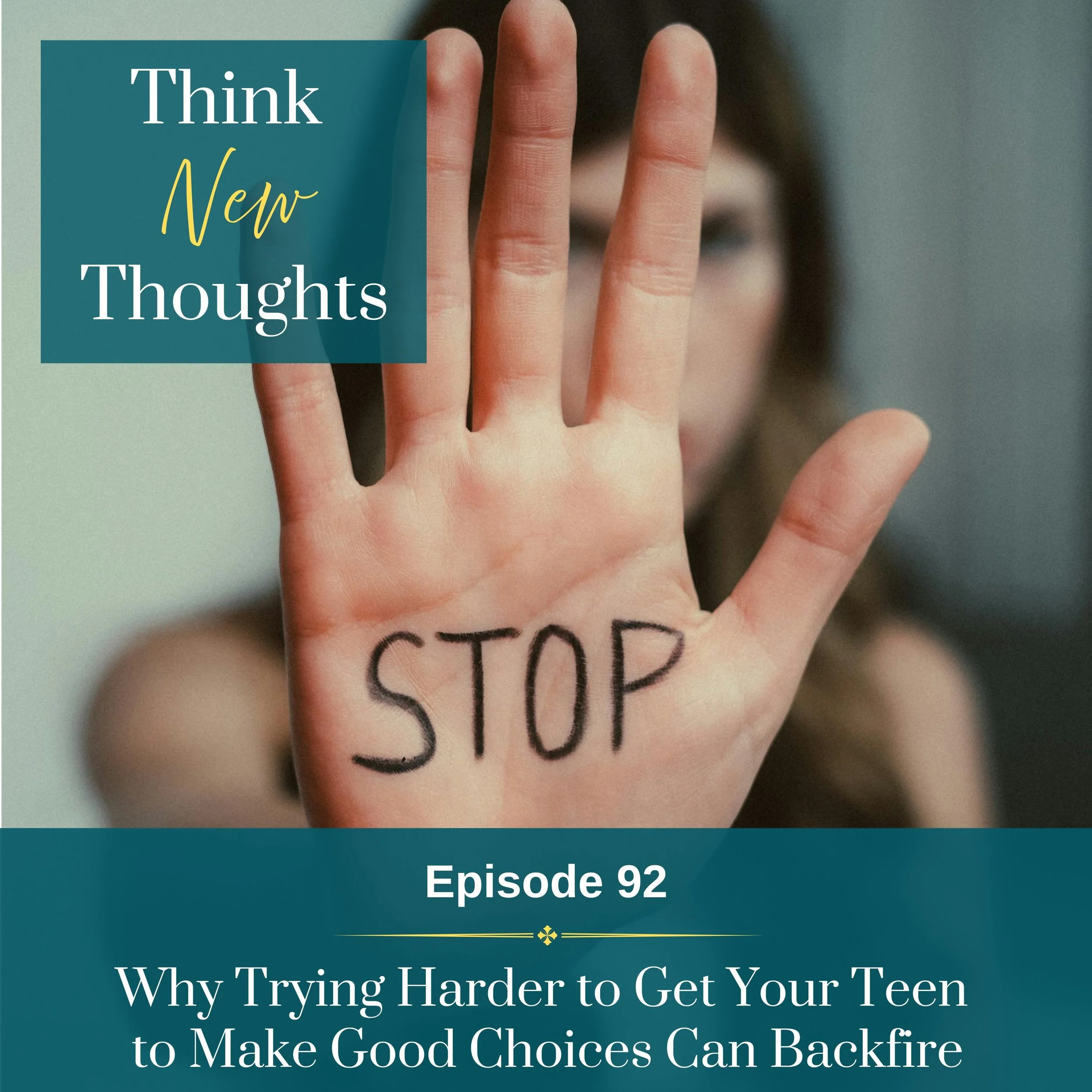
You love your teenager and want what's best for them. But what if some of the things you're doing to help them make wise choices—reminding, lecturing, correcting, even worrying—are actually making it LESS likely that they'll make good decisions? In this episode, we'll explore why trying harder often backfires and what to do instead if you want more connection, trust, and respect in your relationship with your teen.
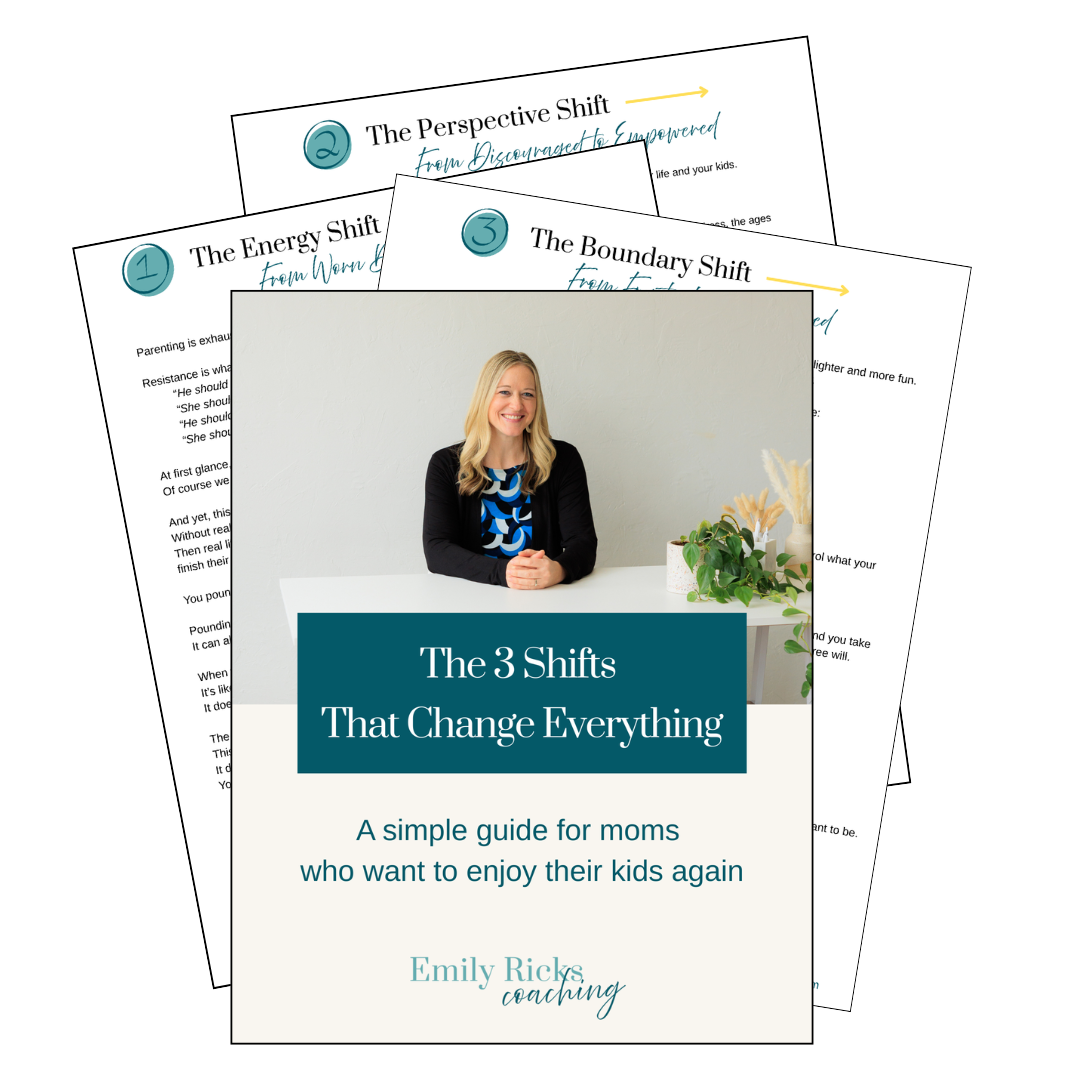
Download My Free Guide
The 3 Shifts
That Change Everything
Whether your kids are little, grown, or somewhere in between, this guide will help you move through discouragement and back to joy in your parenting
Full Transcript:
Ep #92-Why Trying Harder To Get Your Teen to Make Good Choices Can Backfire
Welcome to Think New Thoughts, a podcast helping LDS moms struggling to connect with your teen let go of control and create peace from the inside out so you can show up as someone your teen wants to talk to and feel more anchored, hopeful, and confident as a mom. I'm Emily Ricks, life coach and mom of four, and I'm so glad you're here.
What You'll Discover in This Episode
In this episode, you'll discover the two beliefs that can turn your parenting into an emotional roller coaster, how nagging, reminding, lecturing, or punishing your teen actually decreases your influence, and how to get off the emotional roller coaster in a way that builds trust and respect in the relationship.
If you've been around for a while, you might have noticed that the intro is a little different today. Over the next few months, the podcast will be going through some changes and become more tailored to helping moms with teenagers apply coaching tools specifically to their challenges. If you don't have teenagers, or if you're not even a mom, the tools I teach here will still help you find more joy in any relationship in your life, so I hope you'll stick around.
Full disclosure, the perfectionist in me would like to stop publishing episodes until all the changes to the podcast are complete, but we're not going to do it that way. It's going to be like driving on a road that is also under construction, so thanks for being here. Excuse the cones and the mess for the next little bit, and let's dive into today's episode.
The Coat Analogy
Imagine that you're inside your house and feeling a little chilly. You go find your teenage daughter and say, "Here, put this coat on." She says, "I don't want to wear a coat right now." You respond, "Well, I'm really cold, so I need you to put this coat on so I can be warm." She refuses again, and so you start to push harder. "You really need to wear this coat. Wearing coats is really important. You have to put this on." She rolls her eyes, and you keep pressing harder and harder to get her to wear it.
This sounds ridiculous, right? You're trying to regulate your own temperature by getting your daughter to put on a coat. Even if she puts it on, it's not actually going to make you warmer. A much easier strategy would be to put a coat on yourself or bump up the thermostat a few notches. It would be much easier to regulate your own temperature than to try to get your daughter—who doesn't want to wear a coat—to wear one.
This is obvious in this scenario, but I see so many moms do this with teenagers emotionally. Instead of regulating our own emotions and adjusting our own internal thermostat to feel at peace, we delegate that responsibility to our teenagers and try to get them to do things so we can feel okay.
Think about a place in your life where you've attached something your teenager does—or doesn't do—to your own emotions. "I need you to clean up your room so I don't feel disgusted." "I need you to graduate from seminary so I won't feel embarrassed." "I need you to get good grades so I can feel like a good mom." "I need you to choose good friends so I won't worry about you."
Do you see how these are all a version of saying, "I need you to put on a coat so I won't be cold?"
The Two Beliefs Creating the Roller Coaster
If you have a kid who always cleans their room, gets perfect grades, makes perfect choices, and constantly expresses appreciation, this strategy might work. But if you live in the real world and have kids who don't always make the decisions you hoped they would, you'll end up feeling disgusted, embarrassed, worried, and disrespected a lot. And you'll also feel frustrated that your teenager isn't doing a better job regulating your emotions for you.
Think about how this works. If they make good choices, you get to feel good. If they make bad choices, you have to feel bad. And suddenly you're on an emotional roller coaster going up and down and up and down until you feel like you want to puke.
Here are the two beliefs that keep you stuck on that roller coaster:
My teenager's actions determine my feelings.
My actions determine my teenager's results.
In coaching, we use the CTFAR model. Circumstances are neutral. Thoughts are optional. Thoughts create feelings. Feelings drive actions. Actions produce results.
The truth is that you have your own model. Your thoughts create your feelings, which drive your actions, which produce your results. Your teenager also has their own model. Their thoughts create their feelings, which drive their actions, which produce their results.
Where we get into trouble—especially when parenting teenagers—is when we crisscross those models.
What Happens When You Crisscross the Models?
Imagine your model and their model sitting side by side. Then imagine crossing the wires. You start believing that their actions determine your feelings. But that's not actually true. Your thoughts determine your feelings. You may have thoughts about your teenager's actions, but their actions themselves are not causing your emotions.
Likewise, if you believe your actions determine your teenager's results, you're crossing the wires again. If they're not creating the results you hoped for, you'll believe you simply need to do more somehow.
When you operate from these beliefs, here's how you tend to show up: you nag, criticize, lecture, threaten, and eventually yell. You'll do all of this because you think your actions will create better results for your teenager.
But will they?
Think of a time you've nagged, criticized, or lectured your teen. Why? Maybe you were trying to get them to do their homework. Why? So they could get good grades. Why? So they could get into a good college. Why? So they could be successful in life. Why does that matter? So you can feel like a good mom. So you can relax. So you don't have to watch them struggle.
Ah. Now we're getting to the heart of it.
Sneaky emotional regulation.
The Cost of Nagging
You've handed your teenager your emotional remote control. And unfortunately, teenagers are terrible at regulating your emotions.
But let's also evaluate how well nagging, reminding, criticizing, and lecturing actually work to help your teenager become a responsible adult. Maybe you get compliance. But if they do the thing, it's often because they want you off their back—not because they value the outcome themselves.
And if they don't do it, you end up in a power struggle.
The real magic of raising teenagers isn't compliance. It's influence. It's getting to share, guide, and support as you gradually hand them the reins of their own life and future. When you use them to regulate your emotions, you miss out on that. When you use their choices as your report card and try to manage their decisions so you'll feel okay, you miss opportunities to help them fully exercise their agency.
The Shift That Changes Everything
Instead of believing that they're responsible for your emotions and you're responsible for their results, stay in your own model.
Choose to believe: "I can't create someone else's results. I'm not that powerful."
God gave them agency to choose what they want to think, feel, do, and create in their lives. God gave me agency to do the same for mine. I can influence, but I cannot determine their results.
This sounds simple, but it's a complete game changer.
When you operate from this belief, you no longer need to nag, criticize, lecture, threaten, punish, or yell. You're no longer trying to regulate your emotions through their choices. You're no longer trying to guarantee outcomes. You're simply offering influence.
A Different Conversation
Instead of saying, "I need you to go to church so I can feel like a good mom," you might think, "I don't actually need you to go to church for me. I have my own testimony. I'd love for you to go because I see the benefits for you, but ultimately it's your choice."
Instead of thinking, "I need you to get good grades so I can feel successful as a mom," you might think, "Your GPA is yours. Mine was mine. You can choose what you want. Would you be open to hearing some reasons I think focusing on grades could benefit you?"
Instead of thinking, "I need you to keep the law of chastity so I don't feel scared about the future," you might think, "I choose to live the law of chastity because I believe in it. You create your results through your choices, and I create mine through mine. What results do you want to create in your life?"
Do you see the difference?
If you're trying to get your teenager to do something for you—to manage your fear, worry, embarrassment, or anxiety—you'll tend to use fear, guilt, obligation, or pressure. If you're trying to help them choose something for themselves, you'll focus on helping them understand consequences, outcomes, and what they truly want.
My experience is that teenagers are much more open to your influence when they're completely clear that the final decision belongs to them.
This Week's Challenge
This week, just start noticing.
Observe yourself when you nag, remind, criticize, or punish. Then ask yourself:
Did that bring me the result I really wanted?
If not, remember that there's another option available to you next time. And it starts with choosing to think something new.
If after listening to this episode you're realizing you've been riding an emotional roller coaster and you want to stop nagging, reminding, and criticizing your teen, grab my free guide, The 3 Shifts That Change Everything. It will help you take one step closer to feeling anchored, hopeful, and confident—even if your teen doesn't always make perfect choices.
Thanks so much for joining me today. I'll talk to you next week.
Shownotes:
Feeling a little worn down as a parent?
Grab my free guide, The 3 Shifts That Change Everything.
A simple guide for moms who want to enjoy their kids again.
You’ll discover:
• The Energy Shift that moves you from worn down to wise
• The Perspective Shift that carries you from discouraged to empowered
• The Boundary Shift that takes you from frustrated to anchored
Ready for deeper support?
I offer 1:1 coaching for moms who are ready to experience these shifts in a deeper, more personal way. I’d love to help you renew your mind so you can enjoy your kids again.
