
Episode 91: The 5 Words Keeping You Constantly Worried About Your Teen (And What to Say Instead)
If you've been worrying about your teenager, or feeling like you're not doing enough, this episode might completely change how you think about your job as a mom. Listen in to discover the difference between influence and control—and why understanding that difference can help you enjoy parenting more without loving your kids less.
Download My Free Guide
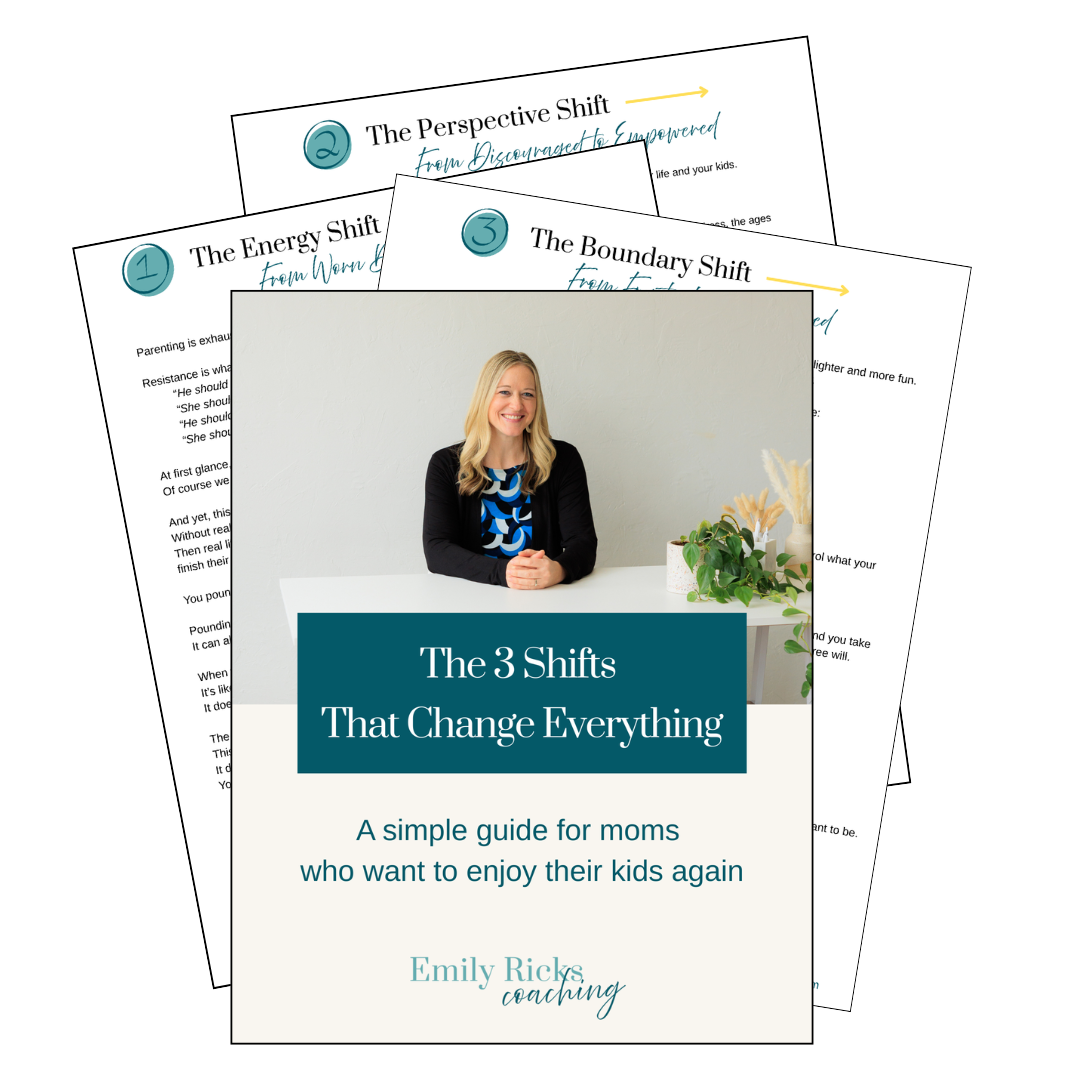
The 3 Shifts
That Change Everything
Whether your kids are little, grown, or somewhere in between, this guide will help you move through discouragement and back to joy in your parenting
Full Transcript:
You're listening to the Think New Thoughts podcast with Emily Ricks. In this episode, you'll discover the five words that may be fueling a lot of anxiety about your teen and what to sayinstead to feel more peace and confidence as a mom.
I'm Emily Ricks and this is Think New Thoughts, a life coaching podcast to help you find more joy in your relationships. In each episode, I'll share a simple idea that will help you see things in a new way so you can love God, your neighbor, and yourself more deeply than you ever have before. If you're ready to literally change your mind, I think you'll like it here.
Hello, my friend.
I'm so glad you're here. Today, we're talking about five words that may be quietly running in the
background of your mind, creating a lot of unnecessary worry in your parenting. These five words
sound responsible.
They sound loving. In some situations, they're even useful. But when it comes to parenting
teenagers, they can create a tremendous amount of pressure, anxiety, and even feelings of
failure.
The five words are, I need to make sure. Now, before you throw these words completely out the
window, let me explain. When your kids are little, these words are often exactly right.
When you have a baby, you need to make sure they're fed, safe, clothed, cared for. When they're
toddlers, you need to make sure they don't drink the cleaning supplies or tumble down the stairs.
When they're young, there are a lot of things that truly are your responsibility.
But then something starts to shift. Your child grows older. They become a teenager.
And many of us continue carrying the same mindset into a stage of parenting where it no longer
works. We start thinking things like, I need to make sure they get good grades. I need to make
sure they choose good friends.
I need to make sure they stay strong in their faith. I need to make sure they don't struggle with
anxiety. I need to make sure they don't make mistakes.
And motherhood becomes incredibly heavy. Because here's the problem. You can teach.
You can encourage. You can remind. You can set boundaries.
You can pray. You can have hundreds of conversations. But none of those things guarantee what
your teenager will choose.
You can influence. You cannot make sure. That's the distinction.And when you define your job as making sure your teen chooses certain things or avoids certain
experiences, you're setting yourself up for anxiety. You're assigning yourself responsibility for
something that isn't actually yours. I think a lot of moms are carrying around an impossible job
description.
Without realizing it, they've decided that their report card as a mom is their teenager's choices. If
my teen is making good choices, I'm doing a good job. If my teen isn't making good choices, I
must be failing.
And that is exhausting. So I want to invite you to rethink your job description. What if you've been
expecting yourself to do something that isn't even actually possible? What if you've been grading
yourself on outcomes that were never yours to control? Let me give you a simple line in the sand.
Imagine two columns on a piece of paper. In the first column, right, things I am powerful enough
to do. In the second column, right, things I am not powerful enough to do.
There are absolutely things you are powerful enough to do. You can teach. You can listen.
You can model. You can set boundaries. You can create connection.
You can pray. You can love. You can apologize.
You can support. In these ways, you have influence in your teenager's life. But there are also
things you are not powerful enough to do.
No matter how much you want to, you're not powerful enough to control another person's
thoughts and other person's feelings and other person's choices or guarantee another person's
results. And that includes your teenager. Their thoughts belong to them.
Their feelings belong to them. Their choices belong to them. Their results belong to them.
In coaching, we talk about the model. You have your own model. Your teen has their own model.
You have thoughts, feelings, actions, and results. Your teen has their own thoughts, feelings,
actions, and results. And anything that belongs in your teenager's model ultimately belongs to
them.
The moment you tell yourself, I need to make sure they choose this. Or I need to make sure they
believe that. Or I need to make sure they don't feel this.
You've crossed the line. You've stepped into the second column. You've assigned yourself
responsibility for something that belongs to another human being.
And that is where anxiety shows up. Not because your teen is making choices, but because
you're expecting yourself to control their choices, which God did not give you the power to beable to do. Now, I want to be really clear.
I am not suggesting that you stop caring. I care deeply about my teenagers. I care about what
they believe.
I care about their friends. I care about their choices. I care about their future.
I care about all of it. But caring and controlling are not the same thing. You can care deeply
without believing that it's your job to guarantee an outcome.
You can love deeply without caring responsibility for another person's agency. So what do you
say instead? Instead of, I need to make sure, try, I'd love to do what I can to help. It's a subtle
shift, but it changes everything.
Instead of, I need to make sure my daughter doesn't end up in a toxic relationship. Try, I'd love to
do what I can to help my daughter develop a sense of self-worth and confidence that will help her
as she makes her own decisions about dating. Instead of, I need to make sure my teenager
doesn't make any mistakes.
Try, I'd love to do what I can to help my teenager learn from his mistakes and become a person
who thinks about the long term as they make decisions. Do you hear the difference? One creates
pressure. The other creates purpose.
Here's what I've noticed. Anxiety pretends to be useful. A lot of moms believe that their worry is
what motivates them to be a good parent.
But when we're anxious, we actually usually don't show up as our best selves. When we're
worried and afraid, that's usually when we lecture. When we threaten, when we try to control,
when we criticize, when we push harder.
And ironically, those behaviors often damage the relationship we're trying so hard to protect.
When I stop trying to control my teenagers and focus instead on influencing them, I become a
different person. I ask more questions.
I listen. I become more curious. I seek to understand.
I create more connection. I become someone my teenagers really want to talk to. There's a quote
from Elder Dale G. Renland that I love.
He said, Our Heavenly Father's goal in parenting is not to have his children do what is right. I
remember the first time I heard that, I'm like, wait, what? It isn't. He continues, it is to have his
children choose to do what is right.
And ultimately become like him. So think about that. The goal isn't control.The goal is agency. The goal isn't forcing the right choice. The goal is helping our children learn
how to choose.
And if that's God's parenting model, maybe it can become ours too. Your job is not to make sure
your teenager chooses what is right. Your job is to lovingly influence, teach, guide, support, and
invite.
And then allow them to make their own choices. So here's my challenge for you this week. Write
down one, I need to make sure thought you've been carrying around about your team.
And then ask yourself, is this something I'm actually powerful enough to make sure of? If the
answer is no, replace it with, I'd love to do what I can to help. Notice how your body feels. Notice
how the anxiety changes.
And notice how much lighter parenting feels when you stop carrying responsibility for things that
were never yours to control. Then this week, spend your energy on what you can influence rather
than on what you can't control. And see what happens.
Shownotes:
Feeling a little worn down as a parent?
Grab my free guide, The 3 Shifts That Change Everything.
A simple guide for moms who want to enjoy their kids again.
You’ll discover:
• The Energy Shift that moves you from worn down to wise
• The Perspective Shift that carries you from discouraged to empowered
• The Boundary Shift that takes you from frustrated to anchored
Ready for deeper support?
I offer 1:1 coaching for moms who are ready to experience these shifts in a deeper, more personal way. I’d love to help you renew your mind so you can enjoy your kids again.
