
Episode 72: The Joy of Accepting Limits
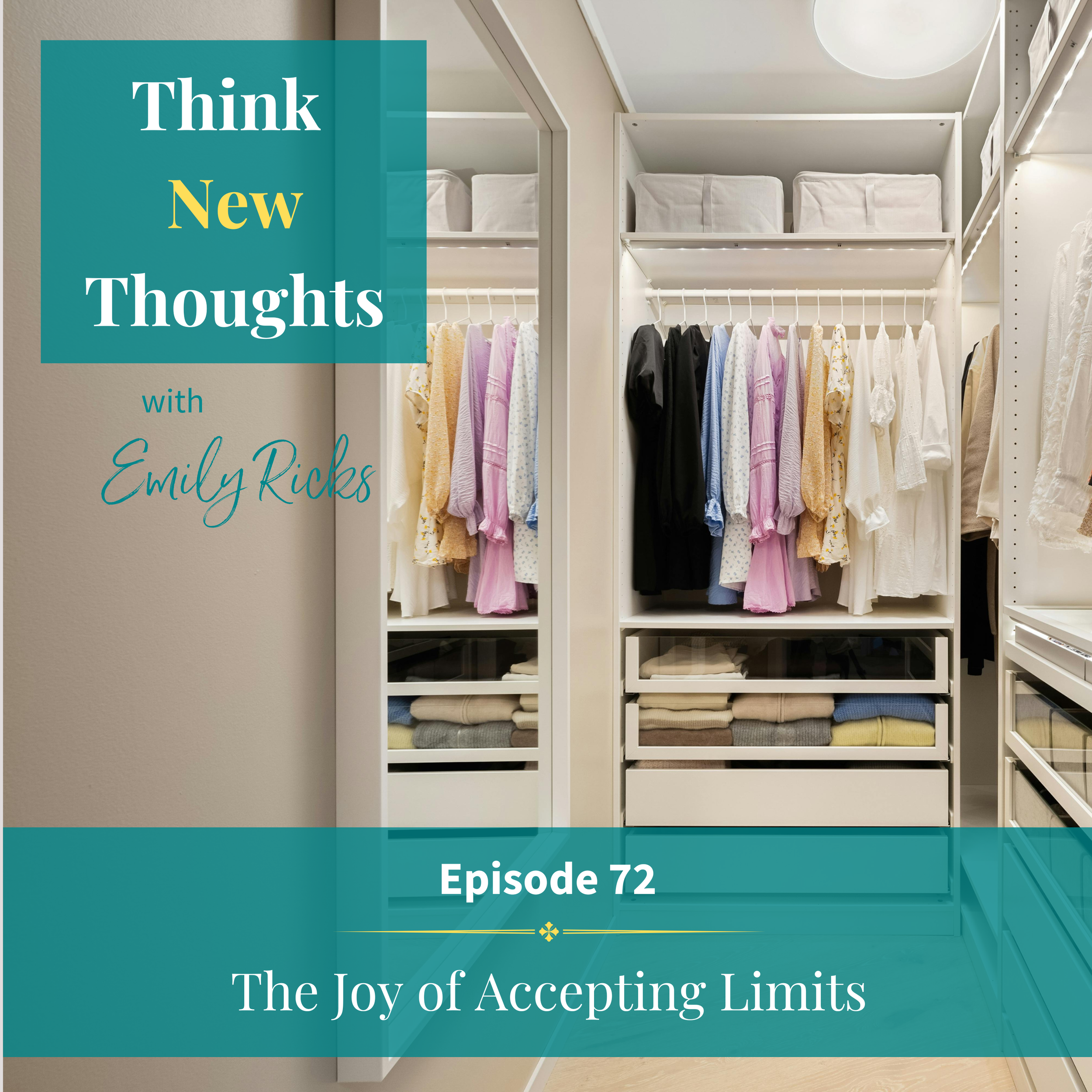
We live in a world obsessed with “unlimited”—unlimited streaming, unlimited plans, unlimited potential. But your closet, your calendar, and your emotional energy definitely have limits. In this episode, I share why accepting those limits isn’t giving up—it’s the key to less overwhelm and more peace. We’ll talk about clutter, time, and control, and how working with reality instead of fighting it can make life feel lighter and more joyful.
Challenge: This week, choose a container in your life (a drawer, a room, a day of the week... your ability to control something outside of yourself) that has been feeling too full and try choosing to simply accept the limits of that space and see what happens. DM me on instagram @emilyrickscoaching and tell me about any discoveries you make!
Come to My Free Webinar: Stop Being Mean To Yourself
Register Here
Full Transcript:
You're listening to the Think New Thoughts podcast with Emily Ricks, episode number 72, The Joy of Accepting Limits.
I'm Emily Ricks, and this is Think New Thoughts, a life coaching podcast to help you find more joy in your relationships. In each episode, I'll share a simple idea that will help you see things in a new way so you can love God, your neighbor, and yourself more deeply than you ever have before. If you're ready to literally change your mind, I think you'll like it here.
Hey, how's it going? Before we jump into today's episode, I wanted to share a podcast review that came in this week. It's called Time Well Spent With My Family, and the listener says, This podcast is brilliant.
My whole family loves Emily's short, powerful episodes. I share this podcast with so many people and they come back telling me how much they love it too. I love how Emily uses real life examples and thoughtfully weaves in her faith in Jesus Christ and scripture.
It's helped me better understand myself and others. I often listen in the car with my kids, a captive audience, and no one ever complains. My youngest especially loves it and it has helped her so much.
We're often able to connect real life experiences as they happen to things Emily has talked about, which has led to some really meaningful conversations as a family. So that's her review. And I love this so much.
So thank you so much for sharing that. I'm really glad to hear that the podcast has been a springboard for meaningful conversations in your family and that it's helped you understand yourself and other people better. That is my greatest hope.
So thanks so much for taking the time to leave that review. All right. So let's talk about accepting limits.
I have some decluttering goals over the next month or two, just wanting to go through some areas of my home and get rid of things that I don't use or don't need or don't have room for. I've been listening to a few new audio books to help me get into a mindset that will fuel me to declutter. And one book I enjoyed reading recently is called decluttering at the speed of life by Dana White.
And I picked up a few new gems from this book that helped me think in some new ways about my stuff and the idea of wanting less of it. One of the concepts that I've been thinking about that she shares in the book is accepting the limits of a container. So I'm calling it the joy of accepting limits, which might sound backwards since I've been thinking about this idea.
I've had the song defying gravity from wicked in my head, you know, where she's like, I'm through accepting limits because someone says they're so, and I'm saying the opposite of that. Like, no, actually let's do accept limits. And there can be joy in that.
I was also thinking about the song from wicked, um, unlimited, like, you know, we, we love in 2026, the idea of things that are unlimited. We have unlimited talk and text on our phone plans. We have unlimited streaming of movies or music on a subscription service, unlimited gym use with a membership, unlimited car washes.
If you have a monthly car wash plan, right? This idea of things being unlimited is very appealing to us culturally. And it's cool in a way. And I am inspired by the idea that there's no limit to your potential.
There's no limit to your imagination. There's no limit to your creativity, right? Like there's so much that's possible, but I also believe in the joy of accepting limits in certain categories of life. So today I want to focus on how accepting the limits in three particular categories of life can be freeing and life-giving.
So first let's talk about physical stuff in terms of clutter. Dana White says a lot of clutter and excess that we accumulate actually comes from an unwillingness to accept limits. Like trying to cram more books onto an already full bookshelf is not accepting the limits of that space.
Trying to cram more shoes or scarves or sweaters into a closet than what actually fits is not accepting the limits of that container. So what happens for a lot of people is they reach the capacity of a container, whether that's the dressers in a drawer, the shelves on a closet, the drawers in a kitchen or an entire house. And then they let things start to spill over into another container.
It won't fit here. So now it's going to be in the garage or it's got to spill over into the basement or onto the dining room table or other surfaces. And then when every last surface is covered with items that didn't fit in the original containers, the closets, the drawers, the shelves that were allocated for those items, and a lot of times people conclude like, oh, my house is too small.
I need a bigger container. And so Dana, the author of this book, she tells her own story of moving into larger and larger homes, thinking that a bigger container would be the solution to her clutter problem, but then always filling a newer, bigger home with more and more stuff until they quote unquote needed more space. And she finally stopped the craziness of this pattern by learning to declutter and developing principles to not have more stuff than fits in her home.
So I love, she says things like your house is a container. It is the size it is. A closet is a container.
It is the size it is. A bookshelf is a container. It is the size it is.
Your kitchen is a container. It is the size it is. So in terms of physical stuff, if you want to have less clutter, and if you want to stop drowning in the idea that you don't have enough room in your home for your stuff, the basic idea is that you fill a container with what fits and then you donate or toss whatever's left.
And this is different than some other decluttering methods, like asking a lot of questions that are very emotional. Do I like this book? Does it bring joy to my life? Do I have fond memories of reading it? Is this book important to me? And it could be that the answer to all of those questions is yes, but that also you don't actually have space to store it. So instead of decluttering by emotion, you can use the container rule, which takes the emotion out of it and leaves it more of a mathematical equation.
I have this bookshelf. This is the container. It is the size it is.
And so I can only have as many books as fit on this particular shelf. So if you're wanting to approach it that way, which can be really liberating and exciting. If you want to live in a house that doesn't have more stuff than fits in your space, then you put the books you love most on the shelf.
And once it's full, you donate the remaining books. And you could do this with socks, or you could do this with sweaters, or you could do this with kitchen gadgets. You could do it with anything.
And then if you find something in your donate pile that you just simply cannot live without, then you use the one in one out rule rather than saying, Oh, but I have to have this because I love this so much. And so I'm going to cram it in and it's not going to fit. You say, okay, which book am I going to take off the shelf? Which kitchen gadget am I going to not keep so that I can keep this one? It's simple, but very, very powerful.
This one practice will keep your stuff from running off into other spaces in the house. And at the heart of it, it is accepting the limits of the space. Acknowledging this container is the size that it is.
I accept that. And now I'm going to work within it. This is something Dana White said.
Once she discovered this way of decluttering every time I felt the relief of not needing to determine the value, whether monetary, emotional, whatever of something. And instead asked myself whether it fit into the container I had for it. I started looking for more ways to put this drama-free strategy to work.
No angst, no emotion, no analysis. I just picked out my favorites, put them in the container and knew that when the container was full, anything left wasn't as loved as the ones in the container. This made decluttering easy or at least doable.
So if decluttering feels really emotional and challenging for you, this is a way that you could approach it. That might be a little bit easier for you. Determine the size of your container and then only put in what fits.
That's it. Dana White talks about doing this with her kids. Like, these are the shelves in the bins where we're going to keep toys.
So put your most favorite ones in. Oh, looks like we won't have room for these ones. So we'll donate these and let other kids enjoy them.
And if they find a toy they can't live without in that donate pile, which toy would you like to take out of the bin so you can make room for that one? This is actually really empowering. It gives people choices, but it's also determining a container and accepting the limits of the container. So for you, think of an area in your home that feels cluttered by stuff.
And then ask yourself, in what ways am I not accepting the limits of my container here? If you think about it, you'll start to see how not accepting the limits is an argument with reality and it's creating frustration and exhaustion. So see if you can determine your container, the room, the shelf, the drawers, whatever it is, put what fits into the container and toss or donate whatever's left. Try on the idea of accepting the limits of the container you have, and you'll be free to enjoy the items you truly love and the open space you create by clearing out the excess.
All right, so that's physical stuff. Accepting the limits of a physical container can free you from the clutter and the frustration of having too much stuff. This same principle can apply to some other areas of life as well.
So let's talk about accepting limits on the container of your time. Think about a day, a week, a month. There are 24 hours in a day.
There are 168 hours in a week. A day is a container. A week is a container.
The container is the size it is. But sometimes we live in a fantasy world where we think that magically we're going to get more time in a day or more days in a week, or that we're going to be able to accomplish a three-hour task in five minutes today if we just work really hard. But that's not accepting the limits of the container.
And it can feel like optimism to take on 100 commitments with the hope that somehow we will magically get more hours to accomplish everything. But in the end, it's actually an argument with reality. Not accepting the limits of a container, trying to cram in more than can ever fit, usually results in frustration and clutter and feeling drained and exhausted and inadequate.
So think about this. Where is that true for you in terms of your time? Where are you not accepting the limits of the container of your time? There's a fascinating thought that I find myself thinking, and I know a lot of other women who think it a lot, I don't have enough time. And isn't that interesting? Because I have 24 hours in a day and seven days in a week, and so does everybody else.
So what do we mean we don't have enough? That's the container. It is the size that it is. So I just want to invite you to consider this.
What could change in your life if instead of trying to cram more in to your time, what if you accepted the limits of the container? What if you lived the container rule and you said, okay, I'm going to fill my day and my week with what I love the most, what's most important. And then I'm going to have a pile of other stuff that doesn't fit. And I'm going to let that go.
Because the truth is we do have limits. You might have unlimited streaming on your device, but your time is limited. And when you accept this, you can actually make better, more intentional choices about what you put into the container when you accept that it does have limits.
So try this idea of accepting the limits of the container and see what happens and see how it can free you and declutter your mind. So instead of trying to do a hundred things and feeling inadequate when you can't, you could focus on 10 things and feel excited and fulfilled after working hard. Okay.
The third category where I believe that accepting the limits of your container can be really life-giving is as it relates to your sphere of control. So CTFAR model, right? We've got circumstances, thoughts, feelings, actions, and results. The model is also a container.
It's a container of what you have control over. So in your model, you actually can't control circumstances. You don't control what happens, what other people say and do, and the different things that you might be faced with.
That's not necessarily in your control, but the other four fifths of the model, thoughts, feelings, actions, results of yours is the container of what you can control. But I see this all the time. People don't accept the limits of this container.
And when you don't accept the limits of the container of your own model, then you want to control other people's feelings. You want to control their thoughts. You want to make sure they don't do things or say things that you don't want them to do.
And this is the emotional equivalent of trying to store 800 boxes of shoes in your closet. It's just not going to fit. You're not accepting the limits of the container and it's going to get messy.
And here's what I also see all the time. Notice this in yourself. I want you to really open your mind and consider when this has been true for you.
When you are focusing on trying to get other people to do what you want them to do, to think how you want them to think, to view you the way you want them to view you, to respect you the way you want them to respect you. What happens in your own container? This is what I see. The woman who is obsessed with how her husband should be more kind or more honest or more helpful ends up over shopping, over eating, over Facebooking, because she's focusing on what she can't control and then not controlling what she can, which is her own model, her own thoughts and feelings and actions.
That's her container. The mother who is wringing her hands in anxiety trying to get her teenagers to make different choices doesn't make time to be still and connect with God, doesn't eat healthy food, doesn't exercise or go outside, doesn't get good sleep, doesn't take care of her own body and mind because she's too busy focusing on the clutter outside of her own container. When you use up all your energy trying to control someone else, you don't have energy left to attend to your own thoughts and your own feelings and your own actions, and you end up with results that you don't like at all because you're not accepting the limits of your container.
You're living in a fantasy world where you think if you try hard enough, you'll be able to make someone else think or feel or behave the way you want them to, but the container is the size it is. What you can control is your own model, the bottom four fifths of your own model, your own thoughts, your own feelings, your own actions and your own results. What I have found is that the more I accept the limits of this container, the more I actually feel love for others.
The more I'm able to be the person and the wife and the mother and friend that I want to be. I show up with so much more love for other people when I accept the limits of what I can and cannot control. So as you're listening to this, what comes to mind? What is a container in your life that is the size that it is that you have not been accepting? This week I want to invite you to choose one container, whether that's with your physical stuff or with your time or with your own model and try accepting the limits of that container.
Really acknowledging this is the size that it is and I'm not going to try to fit more than what fits. Fill the container with what you love, what is important and what you actually can do and then whatever's left, whatever doesn't fit, I want to invite you to let it go and then watch as clutter, frustration and exhaustion begin to change into space, love and additional energy. I'm cheering you on as you try this out.
If you take this challenge and you decide to try it out, feel free to message me on Instagram @emilyrickscoaching and tell me how it was for you. Tell me what you learned. I would love to hear from you.