
Episode 73: The Hidden Cost Of Your Maybes
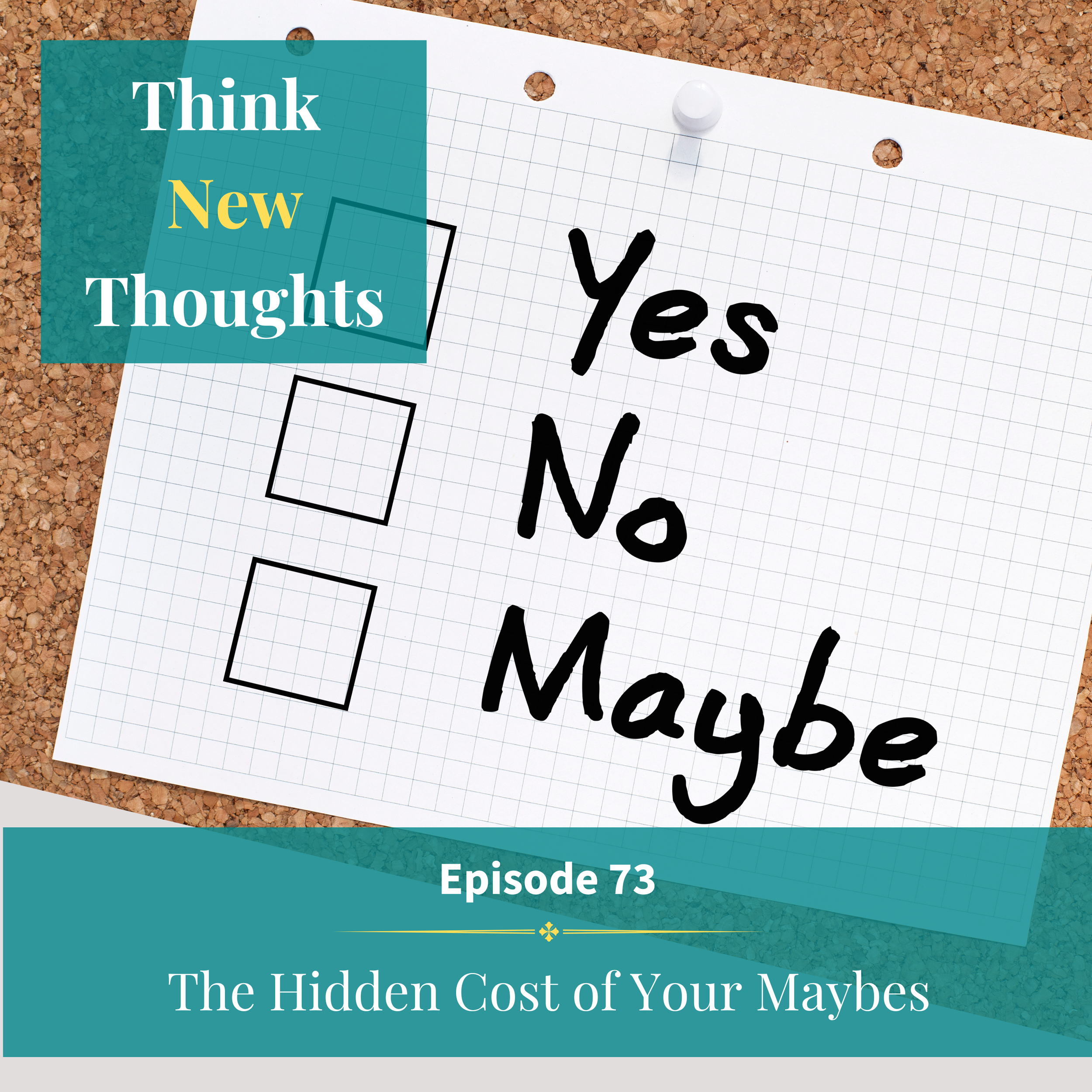
If you’ve been waiting to make a decision because you’re holding out for an option that won’t feel hard, this episode is for you. We’re talking about the hidden cost of your maybes—and why the indecision meant to protect your options may be the very thing holding you back. Tune in to learn how to spot a “miserable maybe,” what it’s really costing you, and the surprising belief that will help you move past your maybe and into a clear decision that will finally move you forward.
Tired of constant negative self talk?
Come to my free webinar: Stop Being Mean To Yourself
Register Here
Curious about coaching?
Schedule a free mini session with me to see what it's like!
Full Transcript:
You're listening to the Think New Thoughts Podcast with Emily Ricks, episode number 73. The hidden cost of your maybes.
I'm Emily Ricks, and this is Think New Thoughts, a life coaching podcast to help you find more joy in your relationships. In each episode, I'll share a simple idea that will help you see things in a new way, so you can love God, your neighbor, and yourself more deeply than you ever have before. If you're ready to literally change your mind, I think you'll like it here.
So sometimes the word maybe can be empowering.
Like when you think about something that might go wrong in the future, and you notice your brain starting to worry, you can gently say, maybe, maybe it would be terrible. But also maybe it would help me grow or bring me closer to God or be a powerful learning experience. This kind of maybe opens your mind to seeing things differently.
Maybe that person is trying to be a jerk, or maybe that person is struggling with something really hard and isn't intending to be offensive. This kind of maybe gives you space to hold your perceptions a little more loosely, and it lets you view your circumstances as neutral, so you can decide how you want to interpret them. I love this kind of maybe, but there's another kind of maybe that is not empowering.
I call it the miserable maybe. It's the decision you put off because you don't want to face it. Miserable maybes live in our closets as clothes we don't wear, but haven't let go of, in our drawers as half-finished projects spilling out everywhere, in our calendars as conversations we keep postponing, and in our minds as questions we keep reopening, but never answering.
A miserable maybe is not when you take extra time to get information or inspiration before deciding. A miserable maybe is when you're avoiding a decision out of fear, fear of what will happen if you say yes, fear of what will happen if you say no. So you wait.
And the waiting itself takes up space, physical space, mental space, emotional space. Today I want to talk about the hidden cost of your maybes and share some strategies to move through them instead of staying stuck. So let's look at what your maybes are actually costing you and how to step out of the misery.
First of all, miserable maybes drain physical energy and create clutter. So look around your house at stuff that has been sitting unused. Chances are there's a thought attached to almost every pile.
A maybe. Maybe I'll have time to fix that someday. Maybe I'll make that phone call.
Maybe I'll finish that project. Maybe I'll sort that stack of papers. Maybe I'll find a top to go with that skirt I haven't worn in three years.
Do you see the pattern? A maybe stops motion. It doesn't go anywhere. It's not a yes, it's not a no, it just sits.
Maybe I'll do that craft with my kids someday. Maybe I'll read those books next week. Maybe I'll get to that project tomorrow.
Each maybe about physical stuff costs you space. And when dozens of maybes pile up, it's easy to get paralyzed and trapped in stacks and clutter. And here's what's ironic.
We often say maybe as a way to try to avoid negative emotion. Like maybe you have a kitchen gadget you never use, but you don't want to get rid of it in case you might someday regret getting rid of it. The truth is you're probably already feeling regret for buying it and not using it.
And so saying maybe I'll use it someday just pushes off that guilt, gives you some temporary relief from it, but it's not really going away. Or you might be holding onto a gift that you don't really like because you don't want to feel guilty for giving it away, but keeping it takes up space and it just presses down the guilt. It doesn't really resolve it because you actually already feel guilty about it.
So that's a miserable maybe. You're kind of lying to yourself to avoid uncomfortable emotions, but you're still feeling those emotions anyway. And each unresolved maybe is a little bit of decision debt that you carry around in your life.
Miserable maybes also drain mental energy and stop progress. Unmade decisions are miserable maybes that pile up in our minds when we put off saying yes or no. So think about some of the maybes floating around in your head.
Maybe I should apply for that new job, but what if I fail? Maybe I should tell someone how I really feel, but what if it ruins things? Maybe I should start exercising, but I don't know where to begin. Maybe I should respond to that email or maybe it can wait. Each maybe quietly pulls at your attention, steals energy and makes every other choice feel harder and heavier.
And the more maybes you have swirling around, the less likely you are to take any action at all because you probably are feeling overwhelmed. So remember a maybe feels safe because it doesn't require any action. A yes or a no invites the next steps.
A maybe might give you temporary relief that feels like, oh great, I don't have to do anything right now, but I want you to know that that comes at a cost. A yes goes on a shelf and your brain starts planning next steps. A no goes out the window and your brain lets go of worrying about it.
But a maybe floats again and again around and around day after day. And every time you think about it, then you feel uncertainty and stress and guilt and maybe even shame. So you press it down.
And it's just interesting because we hold on to maybes a lot of times to invite more possibilities, but holding on to too many actually crowds out the mental space and energy that you need to be able to take action on one or two possibilities. So be careful how many maybes you let yourself indulge in. They take up mental space and they make it harder to make progress.
So here's the third thing that maybes cost you. They steal opportunities. You might say maybe because you're weighing multiple options.
And sometimes you do need more time or you need more information before you're ready to decide. That can be wise. But a lot of times saying maybe is just an excuse to avoid discomfort.
If you say yes to one thing, you say no to the other. But if you say, maybe you don't ever have to say no. So it's perfect, right? If only that were true.
I think about an opportunity that you're waffling over. You can't decide. So you wait, you wait until one option feels perfect.
No obstacles, no negative emotions. Maybe I'll do this. Maybe I'll do that.
But that is a miserable. Maybe if you're waiting for the perfect option, it's a trap because you're never going to find it. And then the opportunity to do either one will end up passing you by while you stagnate in indecision.
Sometimes we worry so much about not wanting to say no to either option that we end up saying no to both in the end. And I don't want that for you. So here is a powerful thought to help you get unstuck.
If you're swirling around in a miserable, maybe, and it might surprise you what this is, but here's the thought. Any decision I make will be 50, 50. Every choice comes with positive emotion and negative emotion with fun parts and hard parts.
So actually there's no decision that I can make. That's going to come without fear or uncertainty or regret or some other sort of uncomfortable emotion. And I think that's really what we're chasing.
When we stay stuck in a, maybe we're waiting for the option that won't hurt, waiting for the option that won't be uncomfortable, but that option doesn't actually exist. So getting unstuck is about telling yourself the truth. So whether your maybe is a physical object or a project or an opportunity, I want to invite you to tell yourself the truth.
Sometimes a maybe is real. It's about gathering information or waiting for the right timing. But if you're using, maybe to avoid negative emotion, I want you to be onto yourself and tell the truth.
Don't pretend that you're going to use something that you know, you never will. Don't pretend you'll take up a hobby that you're actually no longer interested in. If it's a yes, make a plan.
If it's a no, donate it, let it go and move on. Now, if that feels too big and too scary, you can shorten the timeframe of it. Try this, make a decision for the next year.
Either this year I'm going to use this, fix this, finish this or prioritize this and make a plan. Or this year I'm not prioritizing this. There are several other things that are going to come ahead of this.
And I'm not going to do this this year. In this scenario, you don't have to decide for life, but a clear decision for a year can sometimes be enough to break through a miserable. Maybe you will feel negative emotion.
If you say yes, if you've been circling around in a maybe for something like, maybe I'll go back to school. If you say yes to that, yes, I am going to go back to school. Then you're probably going to feel some fear and some uncertainty and some insecurity.
And you're going to have thoughts like, what if I fail? What if this was the wrong choice? How's this all going to work? But you will also feel negative emotion. If you've been circling around in a miserable, maybe, and you say no, if you decide after sitting in a, maybe for a while, finally to donate the supplies from a hobby, you thought you'd love that you actually ended up not really loving, then you might feel some guilt, some regret, maybe even some shame, shame that you didn't become the version of yourself that you had imagined when you bought all of that stuff. Either way, discomfort is coming.
A yes is going to come with some negative emotions. A no is going to come with some negative emotions and a maybe pretends to avoid all that negative emotion, but it's a lie because what a maybe actually does is just press the emotion down. And then you get stagnation, clutter, and procrastination and all sorts of mental noise.
So the real choice isn't how do I avoid feeling bad? The real choice is, do I want forward progress or do I want stagnation? If you want stagnation, you want to sit and not actually go anywhere, choose the maybe, but know this, even a maybe comes with discomfort. Do you see what I'm saying? This might sound depressing, but I find it incredibly freeing. So when I feel stuck in a miserable, maybe I stop looking for the option that won't hurt.
And I tell myself the truth, any decision I make is going to come with some negative emotion, but here's the good news. I can handle feeling any emotion. I can feel uncertainty.
I can feel inadequacy. I know how to feel guilt and regret, even shame. It's just a vibration in my body.
It's not going to harm me. I felt it before. I'm going to get through it.
But if I make a clear decision on this, then I can move forward and stop circling around and around, not getting anywhere. So you can borrow that belief too. No matter what decision you make, yes, no, or maybe it's going to come with some negative emotion, but that's okay because you're capable of feeling any emotion.
And from that belief, you can step out of miserable maybes and into decisions that create clarity and momentum and energy. So give it a try and see if it helps you too. And Hey, if this podcast has been helpful for you and you haven't left a review on Apple podcasts yet, I'd love it.
If you could take a couple of minutes and share one, your review helps this podcast reach more people who need these tools. And it truly means so much to me. Thanks for joining me today.
