
Episode 83: Are You Sure You Want to Hate That?
In this episode, I’m inviting you to pause and really consider something simple but powerful: do you really want to hate things? It’s easy to take a public figure, someone who was rude, your own body, or even something like technology and turn it into the enemy. But when you create a bad guy, then YOU are the one who has to feel the hatred and negativity when you think about it. I’ll walk you through how this pattern quietly drains your energy, shapes how you show up, and pulls you away from the version of yourself you want to be—and how to shift the way you’re thinking if you want to feel more calm, present, and at peace.
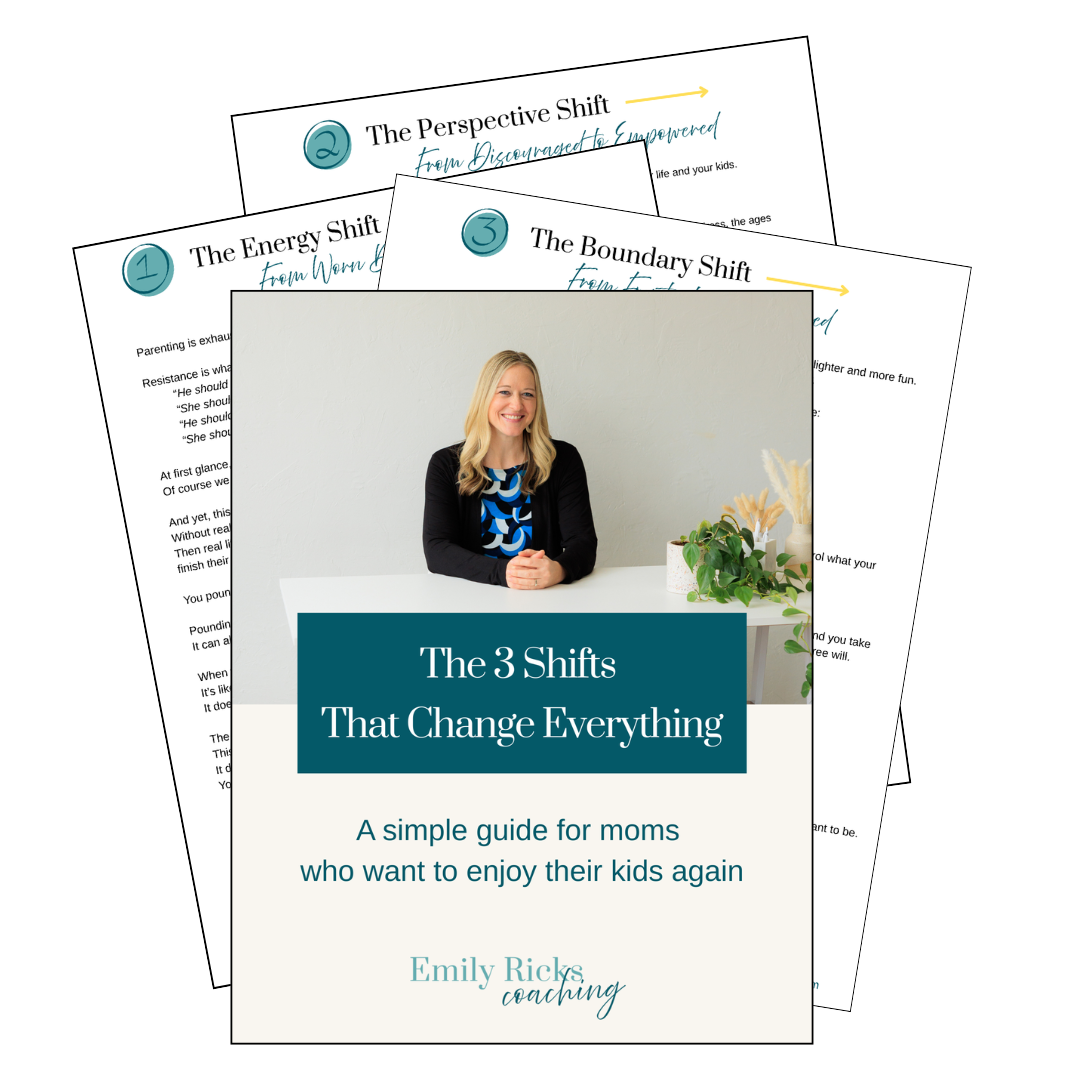
Download My Free Guide
The 3 Shifts
That Change Everything
Whether your kids are little, grown, or somewhere in between, this guide will help you move through discouragement and back to joy in your parenting
Full Transcript:
Ep 83-Are You Sure You Want to Hate That?
You're listening to the Think New Thoughts Podcast with Emily Ricks, episode number 83, Are You Sure You Want to Hate That?
I'm Emily Ricks and this is Think New Thoughts, a life coaching podcast to help you find more joy in your relationships. In each episode, I'll share a simple idea that will help you see things in a new way so you can love God, your neighbor, and yourself more deeply than you ever have before. If you're ready to literally change your mind, I think you'll like it here.
Hello, how are you? I'm so
glad you're here today because we're going to talk about things you hate. Doesn't that sound
so joyful? I want to help you explore today what you have decided to hate in your life and
investigate a little bit what it's costing you to be holding onto that.
So think about it for a second. What is something that you hate? Maybe you hate a person who
was unkind to you or to someone you love at some point in the past. When I was in second
grade, there was this kid named Brian who spit on me at recess, on purpose.
And after that, I kind of decided to hate him. I actually carried that grudge for years. Oh, that's
the kid who spit on me.
That's the guy who's so rude and gross and impolite. So maybe it's something like that, that
you've decided to hate. We can also choose to hate people we've never met.
Politicians, public figures, celebrities, influencers. You don't know them personally, but you
might not like what they stand for or how they act or the decisions that they make. And so you
might decide to hate them or hate their ideas or hate their decisions.
I know a lot of women who hate themselves or parts of themselves. Maybe you blame your past
self for problems that you have now in your life. Like if I had just made better decisions, if I
hadn't done that, I wouldn't be dealing with this now.
And so there's kind of this hatred of this past self, or maybe you hate your body for not being
thinner or prettier or more athletic. So just think about that for a second. What parts of yourself
or your body have you decided to hate? I went through a period of motherhood where I hated
technology.
I viewed it as the enemy, my arch nemesis. Like my kids had this great childhood and I could
control their inputs and what they watched and how much screen time they had. And as they
got older and smartphones became more common and COVID happened and everything was
on a screen, I started to feel really out of control.
And there was a period of time where I hated technology. I felt like it was the villain and I was
the victim and it was going to ruin the whole world. What is it for you? Maybe you hate sugar oryou hate social media or you hate a certain teacher or you hate war or you hate certain kinds of
weather or certain kinds of music.
So I have a question for you. I just want you to consider it. Are you sure you want to hate it? It
takes a lot of energy to hate something or to be afraid of it or to view it as an enemy.
So let's talk about that. Forming an enemy story is a decision that we make. And it's also a
decision that we can reconsider at any time.
And I recommend reconsidering it often because when you have a bad guy in your life, when
you have something you really hate your story about it drains your energy and depletes your
joy. When you create an enemy, you then have a mental relationship with that person or that
thing. And because you're viewing it as the enemy, you will most likely think negative, hateful,
angry, or fearful thoughts about it.
And the more intense your hatred is, the more often you're going to be thinking these negative
thoughts and thoughts create feelings. So if you're constantly thinking, I hate them so much,
you will feel hatred in your body. And if you create an enemy story in your mind, you will think
these thoughts and feel these feelings over and over and over every time you think about them.
So let me see if I can explain what I mean. That kid, Brian, who spit on me, that happened one
time, but I created a story in my mind that I replayed hundreds of times. About how rude that
was, how I didn't deserve him to spit on me, how he was gross.
And those thoughts created feelings of hatred and disdain that I experienced in my body.
Anytime I thought about him, he only spit on me one time, but I replayed that story over and
over and over. I remember one time I was driving to soccer practice.
I was getting a ride from my coach, whose daughter also played on our team. And in the
process of the conversation, this kid, Brian, his name came up. And so what I offered to the
conversation was, well, yeah, that's the kid who spit on me in second grade.
He's so gross. And I remember my soccer coach kind of chuckling and asking some more
questions. And then at one point he laughed and was like, geez, forgive the guy.
But I had decided to hang on to a story of wanting to hate him for something that he had done.
Maybe you hate a politician or an industry or a famous person, and you might feel really noble
hating them because what they believe or what they value doesn't align with what you believe
or value. A lot of times that's why we choose to hate something.
So you might feel really justified in viewing them as a terrible, awful person. But here's
something to consider. Do you value hatred? Do you value anger and bitterness? Because
notice that when you think angry, hateful thoughts about another person, you feel anger and
hatred in your body.And you are the one creating that. We want to blame the other person. No, they're creating all
this anger and hatred, but we're the ones who create that in our own bodies with our thoughts.
So it's just something to think about. Is that what you want to think and feel over and over and
over? What are you gaining from this enemy story that you've created? If you think of your body
as your enemy or whatever part of yourself you've decided to hate, then you will spend a lot of
time resisting yourself, resisting how you feel, resisting what you want, telling yourself you're
bad and wrong for being the way you are. And you might feel really noble hating yourself for
your mistakes and failures and shortcomings.
You might think that all the hate is fueling you to do better and be better. But I just want to
invite you to question that because I believe hating your body or hating any part of yourself
doesn't actually help you improve. Viewing yourself as the enemy fills you with negativity and
resistance.
And that negative story then consumes your thoughts. And that resistance, all that pushing
against yourself drains your energy. And I think it takes you further and further away from
loving God and loving your neighbor and loving yourself.
Instead, you feel hatred and self-loathing and hate isn't a path to love. It just creates more
hatred. So start noticing what you hate, start noticing what you think of as bad and wrong and
what you spend a lot of energy pushing against and notice what you create.
When you form a story where there's a bad guy, when you label something as the enemy, when
you view it as bad and wrong and terrible, and when you decide to hate it, this activates the
primal part of your brain, not the prefrontal cortex, the part of your brain where you make
wise, calm decisions that are best for the long-term. When you have an enemy story, you act
from your amygdala, your animal instinctual brain. When we have established an enemy that
we've decided to hate or fear, then we will feel primal urges to go into fight or flight, to try to
protect ourselves or to protect other people.
And this is really useful if a saber-tooth tiger is chasing you, or if someone is breaking into your
house, but your body isn't meant to have this flood of fight-or-flight chemicals all day, every
day. So it's really draining if you're constantly on hyper alert and feeling threatened and angry
or afraid because of your enemy story. I remember the period of time where I really believed
technology was bad and wrong and it was ruining my kids and ruining our society and our lives.
I felt a certain baseline level of anxiety and anger every day when I was carrying around this
story that technology was my enemy. I remember having a dream one time that I had all these
devices, phones and computers and iPads, and in my dream our house was flooding and I was
trying to keep everything dry and my arms were full of all these devices and I was trying to hold
it all above the water and also keep my insulin pump from getting submerged and all the cords
were starting to get wet and the water was getting higher and higher and it was truly terrifying.
And that's how I felt in real life when I created the story that technology was bad and wrongand the enemy.
And there's another piece beyond just thinking hateful or angry or fearful thoughts and then
feeling hatred or anger or fear. The other piece of it is that then whatever you feel fuels how
you behave, the actions that you take. And I can tell you that how I showed up as a mom during
that time that I was consumed by my enemy story that technology is bad and wrong and
dangerous and scary was the worst version of myself I can remember.
The anger and the fear and the anxiety and the hatred that I felt inside sometimes came out at
my kids. I had trouble sleeping. I didn't take care of my body with rest and food as well as I
could have because I was filled with hatred and fear and resistance.
So that's something to really think about when you form an enemy and you spend lots of time
and energy thinking about it, hating it, resisting it, fearing it. Take a look at how you show up
when you're feeling all that fear and notice that when you choose to create an enemy, when
you choose to hate someone or something and then form that mental relationship where you
think negative thoughts and focus on how much you hate that thing or that person, here's what
inevitably happens. You then either become a villain or you become a victim.
So let's say there's a public figure or a group of people and you don't like what they stand for to
you. They seem hateful and unkind. So then you view them as awful and bad and wrong.
So you spread negativity about them and talk about or post about how awful they are and how
much you hate them. And if you get consumed in anger and frustration, now you're kind of a
villain too, spreading hatred, which you don't want them doing. And you might justify your own
negativity because of what they did first.
But do you see how you can become a villain when you're telling a story about another villain?
The more you hate and focus on how much you dislike this enemy, the more you yourself
become full of hate. That's what villains do. So the other option, if you create an enemy story,
either you sort of have to become a villain or you become a victim where you're helpless and
powerless and doomed to a life of sadness and misfortune because of what somebody else did.
When you have a victim story, you'll feel sorry for yourself and totally disempowered. Like
there's no possible way to change how you feel unless you could go back in the past and have it
be different. Don't do this to yourself.
Don't give someone else that kind of power over your emotions, no matter what they've done.
So instead of choosing to hate and creating an enemy story, instead of making villains and
turning yourself into either a villain or a victim, here's another way that you can think. You can
choose to view other people, not as villains, but as humans who are flawed.
Children of God who are using their agency, making some good choices and some not great
ones. You can choose to view things in this world as 50-50. Half of it's good, half of it's not so
good.You can view yourself as 50-50. Yeah, I have things that I'm good at. I have things that I've
improved in.
I have things that I'm not great at. Things that I'm still working on. If you think about
something like technology, instead of making it the bad guy, you can believe that it's neutral.
It's a tool. It can be used for amazing, incredible things and also for harmful, not good things.
50-50.
Anything in the world can be used for good and also not good. Instead of creating enemies,
instead of having bad guys, you can choose to believe that groups of people are also 50-50.
Some of their ideas are good.
Some maybe not so great. Instead of villain stories, instead of creating bad guys, instead of
black and white ways of viewing the world, when you choose this 50-50 mindset, it becomes
much easier to land at compassion for other people, for yourself. Instead of resistance, there's
a willingness that takes its place.
Like, yeah, I'm willing to be in a world that is full of flawed humans. I'm willing to be in a world
that's 50-50. I'm willing to experience the positive and the negative, the light and the dark.
And as you let go of a bad guy story and shift to viewing the world as 50-50 and accepting the
light and the dark, instead of trying to control other people, the question becomes, okay, who
do I want to be in this? How do I want to respond? So as you consider something in your life
that you've decided to hate, let me ask you one more time. Are you sure you want to hate that?
I want to invite you to consider what is it costing you to form enemy stories? What is it costing
you in mental energy, in negative emotion, and in the actions that come from anger and fear
rather than love? Here's a gentle reminder as you ask yourself if you want to keep hating. This
is what Jesus taught.
But I say unto you, love your enemies, bless them that curse you, do good to them that hate
you, and pray for them which despitefully use you and persecute you. That's a pretty tall order.
What do you feel when you hear that? A lot of people who have been mistreated think
something like, well, I'm not going to love someone who did something so terrible.
And that resistance makes sense. It feels logical. But here's another way to think about it.
What if praying for them, what if choosing to love them isn't something you do for them? What
if it's something you do for you? Choosing to drop your enemy's story is actually a gift you give
yourself. Because then instead of thinking hateful, angry thoughts and feeling hatred and
anger, if you're loving someone, if you're praying for them, if you're blessing them no matter
what they did or have done, you get to feel love. And why would you choose not to feel love? Or
maybe you don't want to love someone who is mean or cruel or selfish because you feel like to
love them would be to agree with something that's wrong.But choosing to feel love for someone or something else doesn't mean surrendering your
values. In fact, the opposite is true. If you're a follower of Christ, then choosing to think loving
thoughts and feel love for any other person, no matter what they have done is actually one of
the most powerful ways you can live in alignment with what you value.
When you choose to let go of an enemy story or not form one in the first place, when you
choose compassion over hatred, acceptance over resistance, you get to love God. You get to
love your neighbor. You get to love yourself.
And isn't that who you want to be? Isn't that actually the life you want to live? So let me close
today by sharing about the 4-8 principle. I've talked about this before. This comes from coach
Tommy Newberry.
He calls it the 4-8 principle because it comes from Philippians chapter four, verse eight, which
says finally, brothers and sisters, whatever is true, whatever is noble, whatever is right,
whatever is pure, whatever is lovely, whatever is admirable. If anything is excellent or
praiseworthy, think about such things. And that sounds like the opposite of an enemy story,
doesn't it? 4-8 thinking is a choice.
You can focus on the good in the world, in yourself, in your spouse, in your kids, in the place
you live. You can think about and dwell on what is pure and lovely and praiseworthy. You can
also do the opposite.
My husband and I call it 8-4 thinking because it's the opposite of 4-8. You can turn anything you
want into a bad guy and focus on what is dishonest and wrong and awful about it. But you have
to buy that enemy story and it costs energy.
It costs emotion and it costs peace. You can keep your enemy stories or you can question them.
When you choose 4-8 thinking instead of enemy thinking, when you choose to love and pray for
your enemies, when you look for and dwell on what is virtuous, lovely, and of good report,
instead of focusing on and hating what is impure, ugly, and awful, you create a totally different
experience in your life.
So as you notice your thoughts this week, I want to invite you back to this simple question. Are
you sure you want to hate that? And the answer you give to that question is shaping your life
more than you might realize. Hey, if you enjoyed this episode and you've been feeling a little
worn down in motherhood, I created something for you.
It's called the three shifts that change everything. A simple guide for moms who want to enjoy
their kids again. Whether your kids are little, grown, or somewhere in between, this guide will
take you from worn down to wise, from discouraged to empowered, and from frustrated to
anchored.
I'd love to share it with you. You can download it for free at EmilyRixCoaching.com. And there's
also a link in the show notes. Thanks so much for joining me today.I'll talk to you next week.
Shownotes:
Feeling a little worn down as a parent?
Grab my free guide, The 3 Shifts That Change Everything.
A simple guide for moms who want to enjoy their kids again.
You’ll discover:
• The Energy Shift that moves you from worn down to wise
• The Perspective Shift that carries you from discouraged to empowered
• The Boundary Shift that takes you from frustrated to anchored
Ready for deeper support?
I offer 1:1 coaching for moms who are ready to experience these shifts in a deeper, more personal way. I’d love to help you renew your mind so you can enjoy your kids again.
