
Episode 84: The Freedom of Accepting Trade-Offs
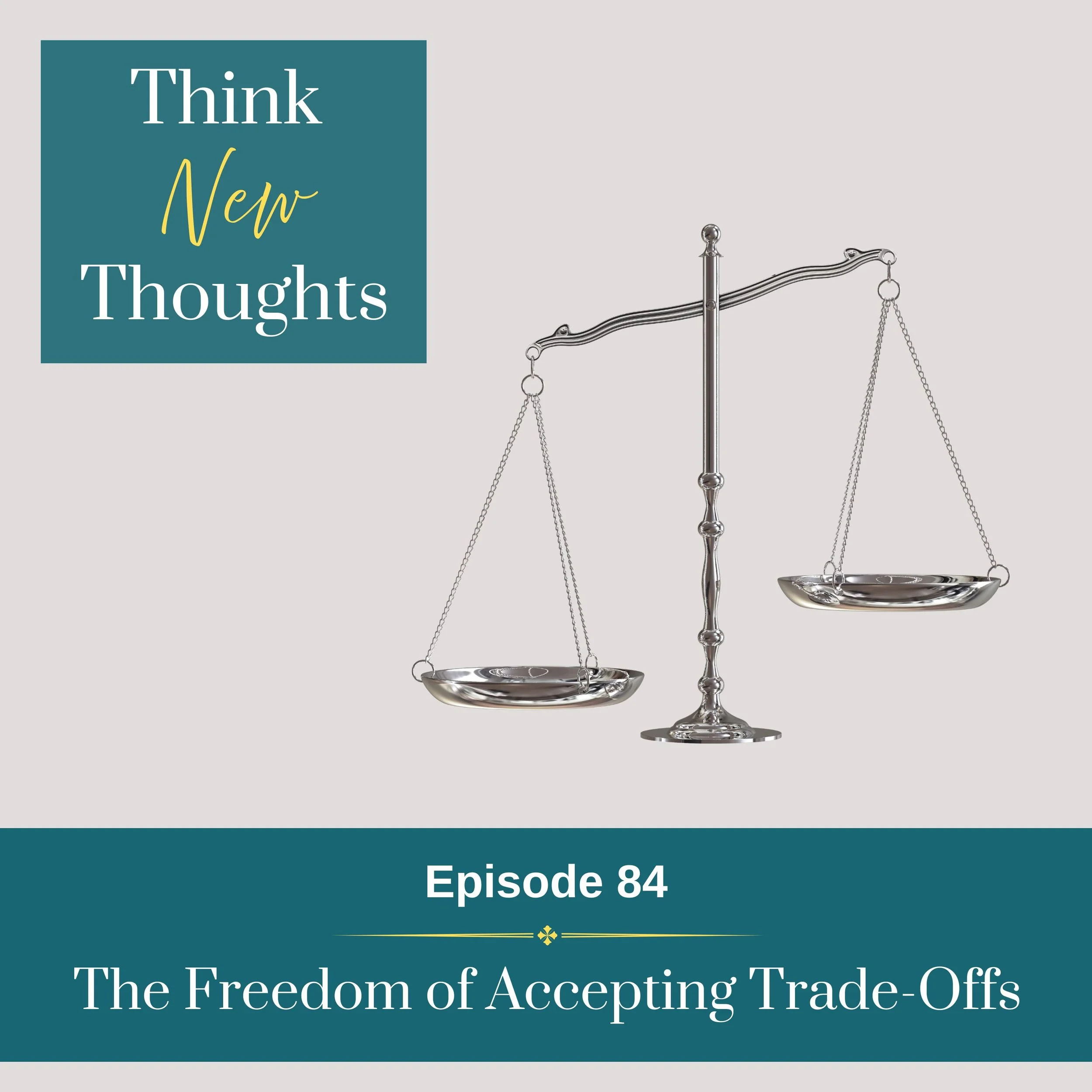
If you’ve ever felt like your life should be better than it is—or like no matter how hard you try, it’s never enough—this episode is for you. I’m sharing a simple perspective shift that has helped me loosen my grip on perfectionism and feel more joy in my everyday life. We’ll talk about how perfectionism shows up as a resistance to trade-offs, and how accepting that any decision will be 50/50 can bring more clarity, freedom, and peace. This one has been a game changer for me—and I think it will be for you too.
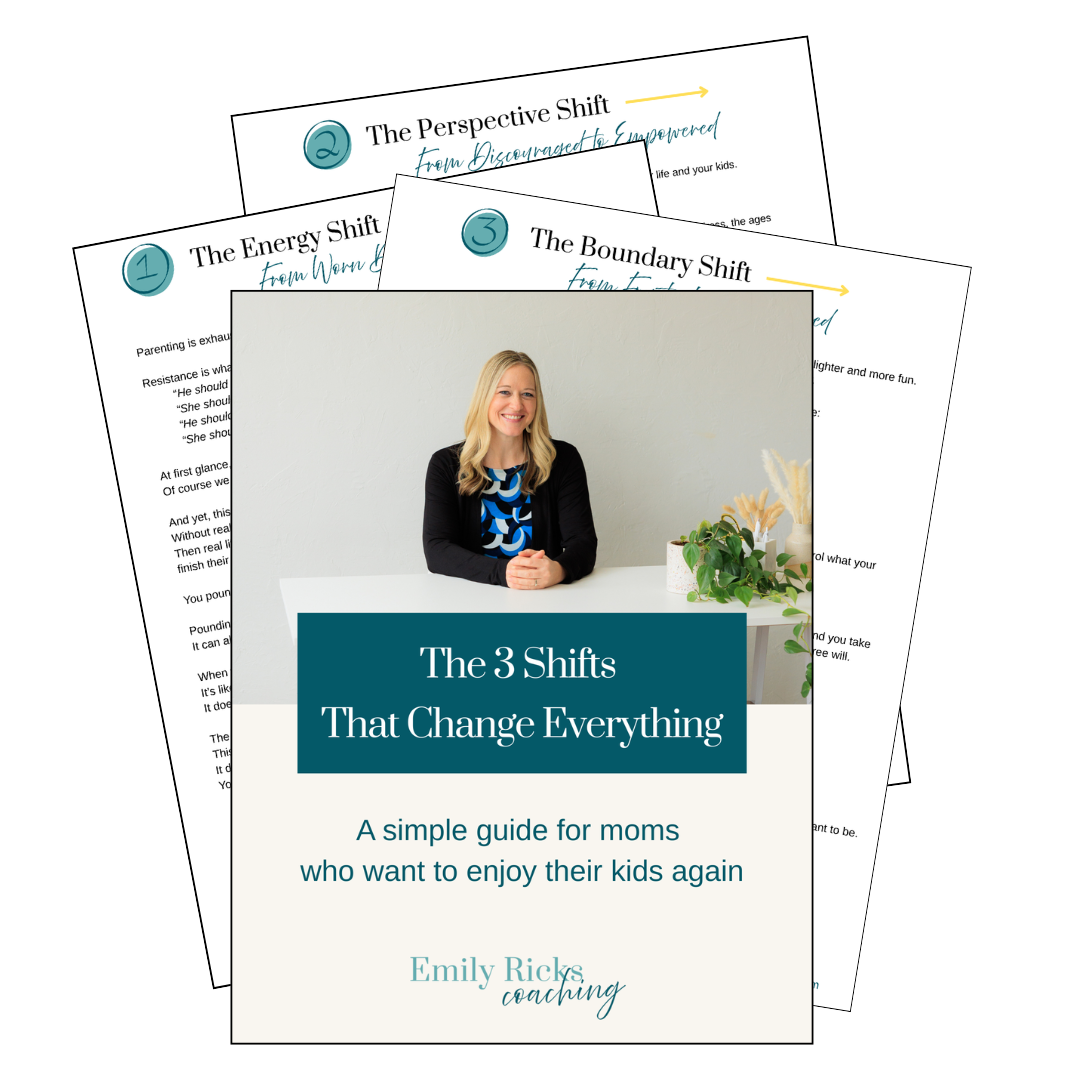
Download My Free Guide
The 3 Shifts
That Change Everything
Whether your kids are little, grown, or somewhere in between, this guide will help you move through discouragement and back to joy in your parenting
Full Transcript:
Ep 83-Are You Sure You Want to Hate That?
You're listening to the Think New Thoughts Podcast with Emily Ricks, episode number 84, The Freedom of Accepting Trade-Offs
I'm Emily Ricks and this is Think New Thoughts, a life coaching podcast to help you find more joy in your relationships. In each episode, I'll share a simple idea that will help you see things in a new way so you can love God, your neighbor, and yourself more deeply than you ever have before. If you're ready to literally change your mind, I think you'll like it here.
Hey, how's it going? You
ready to think some new thoughts today? Let's talk about perfectionism. I think of myself as a
recovering perfectionist, and when I found coaching, it helped me in several ways, but one of the
biggest ones was learning how to let go of perfectionism, so I could experience more joy.
And this wasn't a one-time event, this is something that I continue to use coaching tools to do
regularly. Perfectionism to me is this belief that things should be better than they actually are. It's
having an ideal or a standard so high that no matter how hard you work, no matter how much
progress you make, it's never enough.
One of the main purposes of this podcast is to help you feel more present, more patient, and
more joyful in your life, especially within motherhood, but really, if you're listening and you're not a
mom, these tools apply to all areas of your life. So today I want to walk you through a perspective
shift that has helped me so much. We're going to talk about why perfectionism steals your joy, the
sneaky way it shows up as a resistance to trade offs, and how accepting trade-offs can actually
give you more freedom, clarity, and peace.
So first let's talk about why perfectionism is such a joy killer, because instead of being able to
enjoy what you have, perfectionism wants you to believe that you should have something
different. You should be more successful. Your kids should be higher achieving.
Your house should be cleaner. Your body should be thinner. Your husband should be more
helpful.
Even thoughts like I should be more patient. I should be more loving. I should be more spiritual.
They sound really lovely and positive, but when they're coming from a place of fighting against
the reality of what is in this moment, that's perfectionism sneaking its way in. Perfectionism robs
you of enjoying the life you actually have because you're waiting. You're waiting to love yourself
until you're better or different.
You're waiting to love your home until it's cleaner or more finished. You're waiting to fully enjoy
your kids until they're more obedient or more responsible. You're waiting to enjoy your marriage
until it's exactly how you think it should be.You're waiting to enjoy your life until it measures up to how you envisioned it would be. And that
is not a joyful way to think. It's not a joyful way to live.
So here's the next piece. And this is the part that really changed things for me. I heard someone
say once that perfectionism is the unwillingness to accept trade-offs.
And I think I literally gasped when I heard that. I was like, what? That's me. So much of my life, I
was trying to find a way around trade-offs.
Like how can I figure out how to do it all, how to have it all without any downside. And I am
unlearning that because I have found so much more joy in a willingness to accept and embrace
trade-offs. So what are trade-offs? A trade-off is a giving up of one thing in return for another.
It's a balancing of factors that are not all attainable at the same time. And the truth is we live in a
world full of trade-offs. We exchange money for clothes or food or experiences.
You give up the money in exchange for the outfit. You give up the money in exchange for the
meal. It's a trade.
If you get the shirt and you also keep the money, that's called stealing. When we earn money, we
give our time. We give our energy.
We give our skills. And in exchange, we receive money. That's a trade-off.
We give up sleep to feed a baby. We give up energy or time in order to serve someone else.
Trade-offs are a part of life.
And yet a lot of times we resist them. And this resistance shows up sometimes in sneaky ways. It
sounds like I should be able to have this without that.
Like I should be able to go to bed late, wake up early, eat whatever I want, and never feel tired.
It's like, really? You can think that way, but it's not reality. There are trade-offs.
And when we push against them, it creates so much unnecessary frustration and exhaustion. So
really this way of overcoming perfectionism is really an energy shift from resistance into
acceptance. So let's talk about what happens when you start accepting trade-offs instead of
resisting them.
Because this is where things start to feel lighter. I remember when my kids were little, there were
days where I just really wanted alone time, uninterrupted time. And quiet time or nap time during
the day didn't quite fill that bucket for me because there were still so many things that would
come up and so many interruptions that would happen.
So sometimes, even though I knew I would be tired the next day, I would choose to stay up late. Iwould journal or work on a project or write a song or do something that would really refuel me
emotionally. And there was a trade-off.
I would be physically tired the next day, but emotionally recharged. And so there's the decision
point there. I can go to sleep now and get more rest than feel that craving for alone time, or I can
stay up late, get what I need emotionally and be more tired physically.
And here's the shift. Both options are good. Both options have a cost.
And I just get to choose one, not the same choice every day, but I do get to choose. And that
feels empowering. What feels disempowering is the story like, motherhood is so draining.
I'm always so tired. I never get any time to myself. What feels empowering is today.
I'm going to refill my personal emotional bucket. And I'm going to accept the trade-off that comes
with that decision. I'm not going to get everything I want all day every day, but I do have power in
my life to make decisions that overall are going to help me take care of myself and my family and
fill up all the buckets.
So if you are unwilling to accept trade-offs, this shows up in all sorts of other areas of life too. So I
want you to start noticing where do you feel stuck? Because a lot of times that's a clue that you're
resisting trade-offs. The perfectionism, the unwillingness to accept trade-offs can show up as
decision paralysis.
Like you're trying to make a decision, but you can't move forward because you can't find the
option that gives you everything you want all at once. For example, let's say you're looking to buy
a house. You could choose a smaller house and save money or a bigger house that fits your
family better.
But maybe the trade-off is financial and it would require fewer vacations or cutting costs in
another category. Or maybe you could get the house you want, but the trade-off is a longer
commute. If you're unwilling to accept any of those trade-offs, then you get stuck.
You might keep searching for the option that doesn't have any downsides. The problem is that
option doesn't exist. When you refuse trade-offs, when you won't accept that they exist, then you
lose your ability to choose.
And this is so interesting because we live in a world where we're constantly being marketed to
with the idea that you can have everything you want without any trade-offs. Like lose weight
without counting a single calorie, build muscle without ever working out, get better sleep without
changing your routine, master a new skill without any effort or frustration. And sometimes there
are better, more effective ways of doing things.
And sometimes that marketing can be authentic. But I want to invite you to question this constantmessaging that says you can get something without giving anything. Because a lot of the time it's
not true.
Most of the time to get something you want, you will need to give up something else. Whether
that's time or energy or money or a way of thinking that you've been holding onto, there's going to
be a trade involved. And actually that's great.
It's joyful. If you stop fighting it and lean in and decide what is most important to you, then you
can make exchanges to be able to receive the things that matter most. Sometimes I find it helpful
to think of trade-offs like a teeter-totter.
It's not black and white. Like if I say yes to this, I can't have any of this other thing at all. But
instead I think there are degrees of exchange.
The more I can get of this thing on one side, the less I will get of this thing on the other side of the
seesaw. The more sleep I can get, that side of the seesaw goes up, the less effort I will have to
put into being patient because it's just easier to be patient when I'm not tired. Or another teeter-
totter, like the more I fill my schedule, the less spontaneous I will be able to be.
One side of the teeter-totter goes up, the other side goes down a little bit. It's a trade-off. I can
have lots of things on my schedule and also be spontaneous sometimes, but there's a
relationship between the two that ebbs and flows depending on the decisions I make.
One category where I've really felt this teeter-totter is in parenting. And I like to think of influence
and control as being on a teeter-totter. For me, there is a part of me that would really love to
control everything my kids do and everything they watch and what they eat and what time they go
to bed.
And for younger kids, I think it's reasonable to have your hand in a lot of that. But as my kids have
gotten older, I've found that there's a trade-off. The more I try to control and monitor and compel
my kids to do things a certain way, the less connection and influence I have when we interact.
So think of that teeter-totter. When one side goes up, the other side goes down. The less they
want to share with me, the less they want to open up.
Whereas if I let go of control, if I pull the control down on that teeter-totter, what I get in exchange
is more influence. If I allow them to make lots of their own decisions, if I give them more kite
string, as Dave Ramsey calls it, instead of trying to control what they do, if I acknowledge that
they're old enough to decide so many things for themselves, then I notice that the teeter-totter
goes up on the influence side. And I have way better conversations where I can really connect
with them.
So when the desire for control goes down on the seesaw, what goes up is my curiosity and my
desire to help them think about their decisions. When control is lower and connection is higher,when I'm not trying to get them to do something a certain way, I can ask questions like, what's
important to you in this decision that you're making? Okay, how are you feeling now that it's over?
How do you feel about the way you handled that? Or what are the trade-offs you're considering
as you make this decision? When I am willing to trade control for more connection, I enjoy
parenting a lot more. So that's a trade-off.
I can reach for control. I can be demanding and pushy and have really harsh consequences for
not doing what I say. It's just that when I do that, I can feel the influence side of the teeter-totter
go way down.
And in the end, I want that connection and that space of being able to talk together and explore
more than I want the illusion that I'm the one who's in control of their decisions. So what are the
trade-offs that you're weighing in your life? What are the teeter-totters that you're balancing? Start
noticing where you're telling yourself, I should be able to have both sides of the teeter-totter up at
the same time. And if that's creating frustration for you, consider accepting that you can have one
side up, but not both.
And that's not disappointing. It's freeing. Perfectionism promises you that you're going to be
happy just as soon as you achieve this ideal.
But more joy doesn't come from finding the perfect life. It comes from accepting the one you have
and choosing it on purpose. Cheering you on this week as you take a look at a couple of trade-
offs in your life and choose to embrace them.
Hey, if you enjoyed this episode and you've been feeling a little
worn down in motherhood, I created something for you.
It's called the three shifts that change everything. A simple guide for moms who want to enjoy
their kids again. Whether your kids are little, grown, or somewhere in between, this guide will
take you from worn down to wise, from discouraged to empowered, and from frustrated to
anchored.
I'd love to share it with you. You can download it for free at EmilyRixCoaching.com. And there's
also a link in the show notes. Thanks so much for joining me today.I'll talk to you next week.
Shownotes:
Feeling a little worn down as a parent?
Grab my free guide, The 3 Shifts That Change Everything.
A simple guide for moms who want to enjoy their kids again.
You’ll discover:
• The Energy Shift that moves you from worn down to wise
• The Perspective Shift that carries you from discouraged to empowered
• The Boundary Shift that takes you from frustrated to anchored
Ready for deeper support?
I offer 1:1 coaching for moms who are ready to experience these shifts in a deeper, more personal way. I’d love to help you renew your mind so you can enjoy your kids again.
